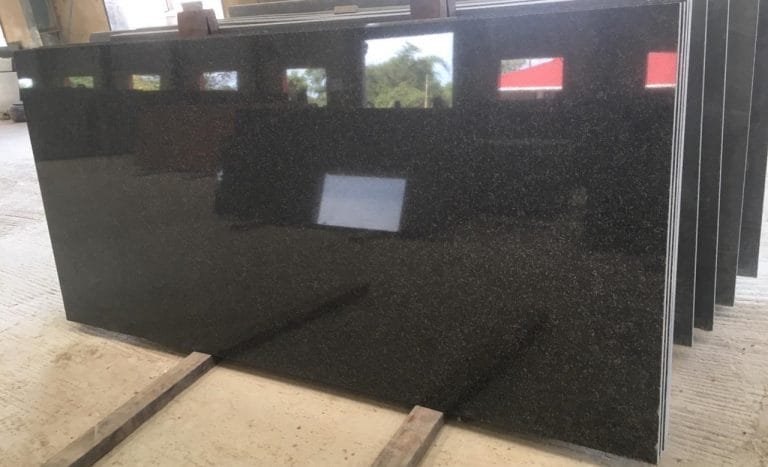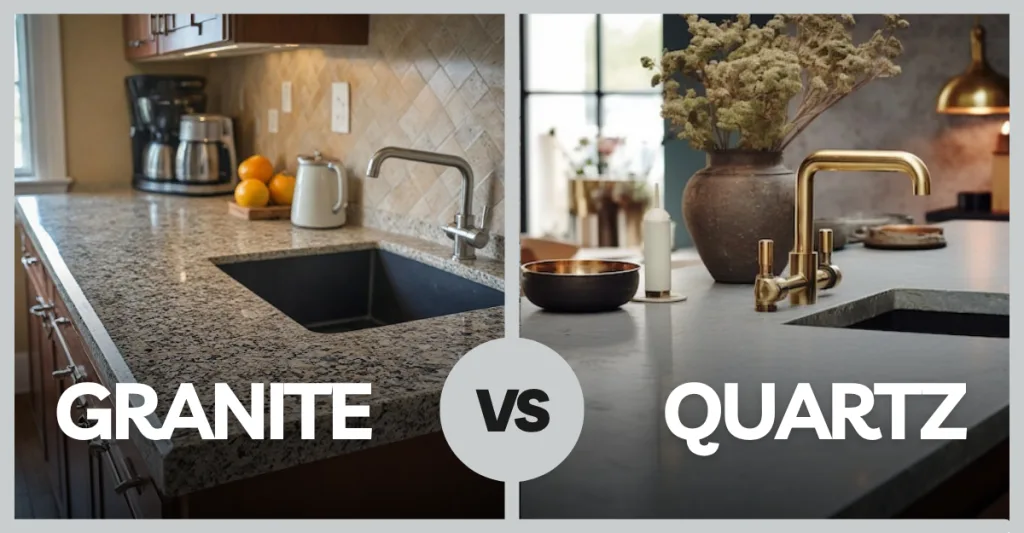
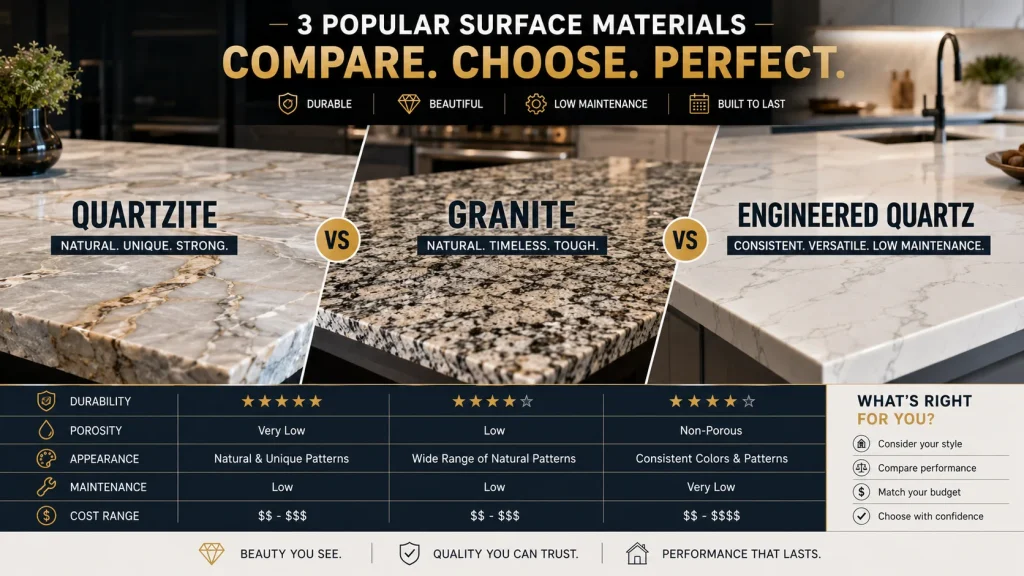
The confusion starts at the name level. Quartzite sounds like quartz, but it’s not quartz — it’s a natural metamorphic rock formed when sandstone gets compressed under heat and pressure until the sand grains fuse into interlocking quartz crystals. Engineered quartz, on the other hand, is manufactured: ground quartz particles bound together with resin and pigment. Granite is igneous — cooled magma, with a mineral mix of quartz, feldspar, and mica locked into a dense crystalline structure. A complete comparison of quartzite, granite, and engineered quartz has to start here, because the material origin is what drives every downstream difference in performance, appearance, and maintenance. Get the material wrong and you end up with a countertop that scorches, a floor that etches, or a facade that degrades within a few seasons.
What Quartzite Actually Is — and Why Buyers Confuse It With Quartz
Quartzite is one of the hardest natural stones you can work with. Because it’s formed almost entirely from recrystallized quartz, it resists scratching more aggressively than most granite — and unlike marble, it doesn’t etch under acid contact. That combination has made it increasingly sought-after for kitchen countertops and feature wall installations where both durability and visual drama are on the brief.
The appearance varies significantly across types. Cristallo Quartzite has a glassy, near-translucent quality — a pale, crystalline surface with subtle grey and white veining that reads clean and cool under natural light. Patagonia Quartzite is more expressive, with wide movement and warm tonal shifts that make each slab look different from the last. Jasper Red Quartzite brings a deep red-brown tone that functions as a statement rather than a background. Amazonite Quartzite sits in the blue-green range and tends to be specified as a feature element precisely because the color is unusual enough to anchor a room on its own. None of these looks can be replicated in an engineered product with the same surface depth.
For the full picture on quartzite’s mineral composition, porosity behaviour, and why specifiers are calling for it more than they were five years ago, the in-depth guide to quartzite’s properties, uses, and rising demand covers the material on its own terms.
Granite’s Strengths: Dense, Versatile, and Outdoor-Capable
Granite is the default choice in many international stone markets for a specific reason: its interlocked mineral structure keeps porosity low enough that outdoor use is viable — something marble and engineered quartz can’t claim. A granite surface on an exterior facade or paved terrace handles frost, rain, and UV exposure without the degradation that resin-bound materials or softer stones would show over time.
The range of granite types and grades is broader than any other natural stone category. Steel Grey Granite and Titanium Black Granite stay cool and neutral. Kashmir White Granite and River White Granite carry pale backgrounds with dark mineral flecking. Imperial Red Granite and Jhansi Red Granite go the full colour saturation route. Patterned types like Colombo Juparana Granite and Indian Aurora Granite show banded, multi-tonal movement that reads close to quartzite in terms of visual complexity, but with the tighter, denser mineral grain typical of igneous stone.
For countertop applications specifically, granite handles heat from pots and pans placed directly on the surface without damage. That’s not a small point — it’s one of the reasons granite remains the dominant natural stone in large-scale export procurement, even as quartzite has grown its share of the high-end residential market.
Engineered Quartz: What You’re Actually Buying
Engineered quartz slabs are manufactured from around 90–95% ground quartz particles bound with polyester resin and pigment. The resin content defines the material’s entire performance profile. It’s what makes engineered quartz non-porous by design — no sealing ever required — and it’s also the reason the material has clear limits.
Resin can be scorched by sustained heat, which is why fabricators consistently advise against placing hot pans directly on an engineered quartz countertop. UV exposure over time can cause some colours to shift or yellow, which rules engineered quartz out for any outdoor installation. Both of those constraints matter less in a low-traffic indoor kitchen, where the sealed surface, easy cleaning, and pattern consistency are legitimate advantages.
Consistency is genuinely useful in some contexts. If you need the same colour and pattern repeated across a long countertop run without slab-to-slab matching concerns, engineered quartz delivers what natural stone fundamentally can’t. The trade-off is that the surface doesn’t carry the visual depth of a quartzite or granite slab. The pattern repeats. It reads more like a photograph of stone than stone itself, particularly under direct light at close range.
The broader question of how to evaluate natural stone against manufactured alternatives for a specific project — including procurement and long-term cost factors — is covered in the full breakdown of natural stone vs artificial stone.
Durability Head-to-Head: Where Each Material Holds Up
Scratch resistance: quartzite leads, followed closely by granite. Engineered quartz sits behind both — quartz particles within it are hard, but the resin binder can be dulled or scratched by grit dragged across the surface, especially over years of use.
Heat resistance: granite and quartzite both handle direct heat well. Engineered quartz doesn’t. The resin binder is the weak point, and a very hot pan can leave a permanent mark.
Acid resistance: granite and quartzite are largely unaffected by mild household acids — lemon juice, vinegar, wine. Engineered quartz’s non-porous surface also resists acidic staining, though that’s a surface behaviour rather than structural chemical resistance. Marble, sitting outside this three-way comparison entirely, is the stone that genuinely etches under acid exposure, and how quartzite compares to marble specifically on durability and surface performance is worth reading if marble is still in consideration for the same application.
Outdoor use: granite is the reliable choice for exterior paving, facades, and cladding. Quartzite can also perform well outdoors depending on finish and type. Engineered quartz should not be used outdoors under any circumstances.
The Full Comparison
| Factor | Quartzite (Natural) | Granite (Natural) | Engineered Quartz (Manufactured) |
| Origin | Metamorphic — recrystallized sandstone | Igneous — cooled magma | Manufactured — ground quartz + resin |
| Scratch resistance | Very high | High | Moderate — resin surface can dull |
| Heat resistance | High | High | Low-moderate — resin can scorch |
| Acid resistance | High | High | High (non-porous surface) |
| Porosity | Low to moderate, varies by type | Low | Near-zero by manufacture |
| Sealing required | Yes, periodic | Yes, periodic | No |
| Outdoor use | Yes, check finish | Yes | No — resin degrades under UV |
| Pattern consistency | Unique per slab | Unique per slab | Repeatable, consistent |
| Veining character | Deep, glassy, complex movement | Speckled to veined depending on type | Shallower, printed or blended |
| Best application | Countertops, feature walls, statement floors | Countertops, flooring, cladding, exteriors | Indoor countertops, low-maintenance settings |
Appearance: The Difference a Slab Tells You in Person
Quartzite’s surface has a translucent, crystalline quality that flat photography doesn’t fully capture. It’s worth seeing a full slab in natural light before deciding — particularly with Cristallo Quartzite, where the depth in the surface becomes apparent in a way that sample chips simply don’t show. Patagonia Quartzite and Amazonite Quartzite carry stronger colour presence, with Amazonite reading as a near-turquoise depending on the light source.
Granite reads differently — denser and more mineral-solid. There’s no translucency. The surface reflects light rather than carrying it through, which gives granite a grounded, substantial quality that suits exterior and high-traffic applications better than quartzite’s more decorative surface character.
Engineered quartz is designed to imitate natural stone, and premium grades do it reasonably well from a distance. The giveaway, when comparing directly to a natural slab, is in the depth. Engineered quartz looks printed. Natural stone looks like something grew inside it over millions of years — because it did.
What Maintenance Actually Looks Like for Each
Both quartzite and granite need periodic sealing. How often depends on the stone type and use conditions. A simple water bead test tells you when resealing is due: if drops sit on the surface, the seal is holding; if they soak in within a few minutes, it’s time to reseal. Neglecting this on a lighter quartzite or granite in a kitchen or bathroom will lead to staining that could have been prevented.
Engineered quartz skips the sealing step entirely. Clean it with mild soap and water. Avoid bleach-based cleaners and high-pH products — both can degrade the resin surface gradually, even if the damage isn’t obvious immediately. That zero-seal requirement is a real operational advantage in commercial kitchens or rental properties where maintenance schedules are inconsistent.
One rule applies across all three: don’t use abrasive scrubbing pads or harsh chemical cleaners. They’ll dull any polished surface, natural or manufactured.
Making the Call
The decision simplifies once you fix the application first. Outdoor installations point directly to granite. Indoor countertops where maintenance consistency is the priority, and pattern repeatability matters more than visual uniqueness, point to engineered quartz. Interiors where the stone is meant to be a focal point — where a slab with genuine crystalline depth and movement is worth the extra sourcing attention — point to quartzite.
Quartzite isn’t replacing granite. They’re filling different briefs, and the overlap is smaller than showroom conversations suggest.
Frequently Asked Questions
Is quartzite the same as engineered quartz?
No. Quartzite is a natural metamorphic rock formed from sandstone under heat and pressure, quarried as natural stone. Engineered quartz is a manufactured product made from ground quartz particles and resin. The names sound similar, but the materials behave very differently in terms of heat resistance, maintenance requirements, and outdoor suitability.
Which of the three is best for kitchen countertops?
All three get used for kitchen countertops, but for different buyers. Granite handles heat directly and needs periodic sealing. Quartzite offers similar heat resistance with more dramatic natural patterning, and also needs sealing. Engineered quartz needs no sealing and offers consistent colour, but can’t handle a hot pan placed directly on it.
Can engineered quartz be installed outdoors?
It shouldn’t be. The resin binder in engineered quartz degrades under prolonged UV exposure and can’t handle the temperature swings outdoor surfaces face across seasons. Granite is the more appropriate choice for exterior paving, cladding, and pool surrounds.
Does quartzite need sealing?
Yes. Quartzite is a natural stone with some porosity, so sealing is recommended — particularly for countertop and flooring applications where liquid exposure is regular. Frequency depends on the specific quartzite type and the conditions it’s installed in.
Is quartzite harder than granite?
Generally yes. Quartzite is formed almost entirely from recrystallized quartz, making it among the harder natural stones available. Granite contains quartz alongside feldspar and mica, making it slightly softer overall — though still more than durable enough for virtually all building and cladding applications.