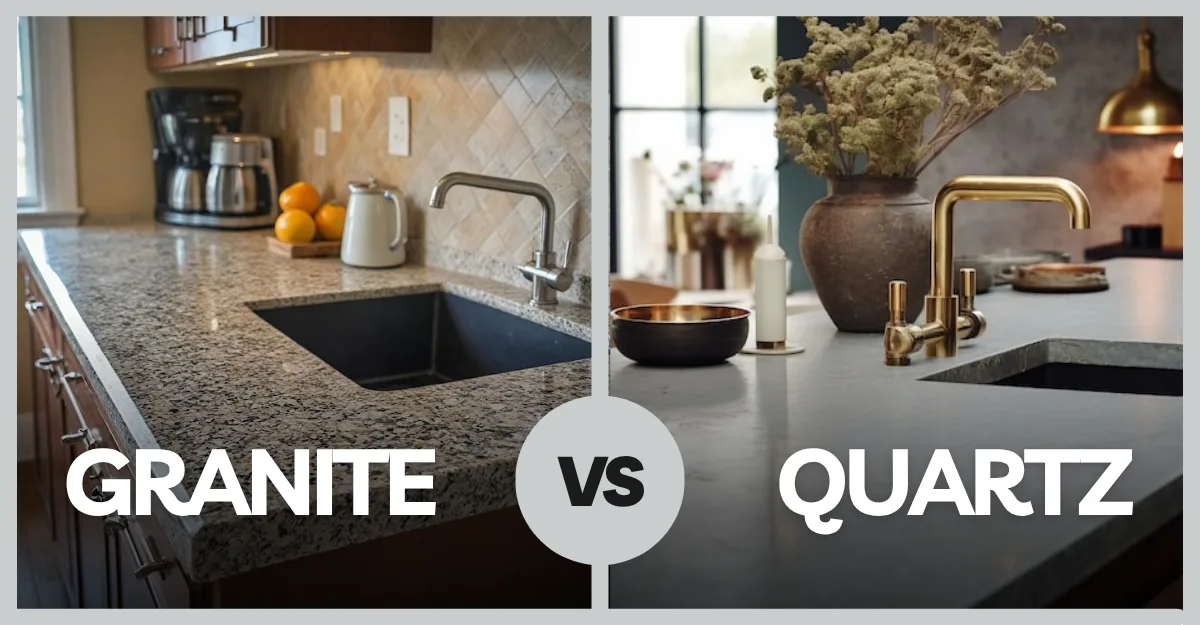

When renovating a kitchen or bathroom, choosing a surface material usually narrows down to two leading options: natural stone or engineered stone. From a distance, these two surfaces can look remarkably similar, but they behave very differently under the stress of daily cooking and living. Understanding the fundamental difference between a granite or quartz countertop matters much more than simply picking a color you like. Let’s explore how these materials compare in reality, so you can choose the right foundation for your space.
What Is a Granite Countertop?
Granite is a 100% natural stone. It is quarried directly from the earth in massive blocks, sliced into a Granite Slab, polished, and installed in your home. Because it is a product of nature, no two slabs are exactly alike, and the mineral composition varies from quarry to quarry.
This natural origin means granite has inherent porosity. The microscopic spaces between the interlocking minerals can absorb liquids if left unprotected. To prevent this, granite countertops require a liquid sealer, which permeates the pores and creates a barrier against stains. Beyond this simple maintenance requirement, natural stone countertops are renowned for their raw durability and organic beauty.
What Is a Quartz Countertop?
Engineered quartz is a manufactured product designed to replicate the look of natural stone while altering its physical properties. It is created by combining crushed natural quartz crystals with polymer resins and color pigments. The mixture is poured into a mold, compacted under intense pressure and heat, and cured into a solid Quartz Slab.
Because the resin fills all the microscopic voids between the quartz crystals, the resulting surface is entirely non-porous. This is the defining feature of engineered quartz vs natural granite. A non-porous surface never requires sealing and blocks liquids from penetrating the material, making it highly predictable and easy to manage in a busy kitchen environment.
Appearance and Aesthetics: Natural Variation vs. Engineered Consistency
The Unique Beauty of Natural Stone
The primary visual appeal of granite is its uniqueness. Mother Nature designs every slab, resulting in complex veins, mineral deposits, and organic color shifts that cannot be perfectly replicated in a factory. If you appreciate one-of-a-kind materials, granite delivers unmatched character.
For a sleek, uniform look, stones like Absolute Black offer deep, consistent elegance that grounds a bright room. If you prefer organic movement, Colonial White and Kashmir White feature delicate speckling and flowing mineral rivers that brighten up traditional and transitional spaces. For those making a bold design statement, exotic granites like Blue Bahia or Vizag Blue provide vibrant, dramatic color palettes that turn a kitchen island into a piece of art.
The Predictable Look of Engineered Quartz
Quartz countertops excel in visual consistency. If you are building an expansive kitchen that requires multiple slabs, engineered quartz guarantees that the pattern and color will match flawlessly across every counter and seam. This uniformity is a major advantage for modern, minimalist designs.
Manufacturers can also manipulate quartz to mimic other materials, such as white marble with gray veining or even matte industrial concrete. While early versions of quartz looked somewhat artificial, modern manufacturing techniques have created highly convincing patterns. However, upon close inspection, the repeated patterns in quartz lack the deep, three-dimensional crystalline structure found in natural stone.
Granite vs Quartz Durability in a Busy Kitchen
Heat and Scratch Resistance
When evaluating granite vs quartz durability, heat resistance is a major dividing line. Granite was forged in the earth under extreme heat, making it exceptionally heat resistant. You can generally place a hot baking sheet directly on a granite surface without damaging the stone, though using a trivet is always the safest practice.
Engineered quartz is heat resistant only up to a certain point. The polymer resins used to bind the quartz crystals can scorch, melt, or permanently discolor if exposed to the sudden, intense heat of a hot pan. For scratch resistance, both materials perform brilliantly. You can prep food and slide heavy appliances across either surface without fear of scratching them, provided you aren’t intentionally dragging sharp steel blades across the finish.
Impact and Structural Strength
Both materials are heavy, dense, and structurally sound, but they handle physical impacts slightly differently. Granite is rigid and can chip if a heavy cast-iron pan is dropped on an exposed edge. Fortunately, a stone professional can usually fill and polish a natural stone chip to blend in seamlessly.
Because quartz contains polymer resin, it has a slight amount of flexibility, making it highly resistant to cracking. However, it can still chip on sharp edge profiles if struck hard. Repairing a chip in engineered stone is sometimes more visible than a granite repair, as matching the artificial resin color and pattern can be tricky.
Granite vs Quartz Maintenance: What to Expect
The conversation around granite vs quartz maintenance often exaggerates the difficulty of caring for natural stone. Granite requires sealing, but this is not a labor-intensive process. A quality penetrating sealer is simply wiped onto the clean countertop, allowed to soak in for a few minutes, and wiped off. This only needs to be done once every one to three years, depending on the specific stone and how much you use your kitchen.
Quartz requires absolutely zero sealing, ever. For daily cleaning, both granite and quartz kitchen countertops should be wiped down with mild soap and water or a dedicated stone cleaner.
The finish you choose also affects maintenance. A polished surface is standard for both, but textured finishes are gaining popularity. For example, a leathered Tan Brown or Ivory Fantasy granite hides crumbs and smudges beautifully, but the textured surface may require a soft brush to clean out deep crevices. Quartz is also available in honed (matte) finishes, but these often show fingerprints and watermarks more readily than polished quartz, requiring more frequent wipe-downs.
Cost and Availability Comparison
When pricing a countertop upgrade, the granite vs quartz cost comparison reveals that both materials span a wide price spectrum. Entry-level granite is often more affordable than entry-level quartz, making it an excellent choice for budget-conscious renovations. Because it is quarried globally, standard granite colors are highly accessible and competitively priced.
As you move into mid-range options, the prices of granite and quartz are largely comparable. However, at the high end of the market, exotic natural stones will almost always cost more than premium quartz. Rare slabs with vibrant blues, greens, or dramatic veining command premium prices due to their scarcity. Quartz pricing is generally based on the complexity of the manufactured pattern rather than natural scarcity.
Matching Materials to Kitchen Styles
Your overall kitchen aesthetic will strongly influence which is better, granite or quartz, for your specific home.
- Modern and Minimalist: Quartz is frequently chosen for contemporary kitchens. The solid colors and lack of unpredictable veining create clean, uninterrupted lines.
- Traditional and Farmhouse: Granite feels right at home in classic designs. The earthy tones and natural movement in a stone like Ivory Fantasy complement wood cabinetry, farmhouse sinks, and traditional hardware.
- Transitional: Both materials work well here. A subtle Indian Granite Slab or a marble-look quartz can effortlessly bridge the gap between traditional and modern design elements.
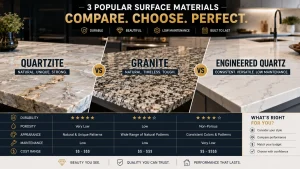
Granite vs Quartz Countertops: Side-by-Side Comparison
| Feature | Granite Countertops | Quartz Countertops |
| Material Type | 100% Natural Stone | Engineered (Quartz crystals + resin) |
| Appearance | Unique, organic variation in every slab | Consistent, uniform, predictable patterns |
| Porosity | Naturally porous | Non-porous |
| Sealing Required | Yes (Typically every 1–3 years) | No |
| Heat Resistance | Excellent (Can handle hot pans) | Moderate (Resin can scorch or melt) |
| Stain Resistance | High (When properly sealed) | Very High (Naturally repels liquids) |
| Scratch Resistance | Excellent | Excellent |
| Maintenance | Mild soap, periodic sealing | Mild soap, zero sealing |
| Cost Range | Wide range (Budget-friendly to highly exotic) | Moderate to high (Fewer budget options) |
| Best Kitchen Styles | Traditional, Classic, Rustic, Bold | Modern, Minimalist, Contemporary |
| Edge Options | Highly customizable (Ogee, bullnose, custom) | Standard profiles (Intricate cuts expose resin) |
Buyer’s Checklist: Narrowing Down Your Priorities
Choosing the best countertop material comes down to being honest about how you use your kitchen. Use this checklist to determine which surface aligns with your lifestyle:
- The Heat Priority: If you regularly move pots directly from the stove to the counter and hate using trivets, granite is the safer choice.
- The Maintenance Tolerance: If the idea of applying a sealer every year bothers you, or if you want a completely inert surface, engineered quartz is your best bet.
- The Aesthetic Preference: If you want a perfectly uniform color or a seamless match across a massive island, choose quartz. If you want a unique piece of earth that no one else has, choose granite.
- The Spill Factor: If your household frequently spills red wine, coffee, or acidic liquids and leaves them sitting overnight, the non-porous nature of quartz offers supreme peace of mind.
- The Budget: If you have a strict, lower-tier budget, standard-grade granite will generally stretch your money further than entry-level quartz.
Frequently Asked Questions
Neither material is universally better; the right choice depends entirely on your lifestyle and design goals. Granite offers superior heat resistance and unique natural beauty, while quartz provides a non-porous surface that requires zero sealing and offers perfect color consistency.
Yes, natural granite must be sealed to protect it from absorbing liquids and staining. However, sealing is a simple, inexpensive wipe-on process that only takes a few minutes and is usually done just once a year.
No, you should not place hot pans directly on a quartz surface. While the stone crystals resist heat, the polymer resins binding them together can melt, scorch, or leave a permanent cloudy mark under sudden, intense heat.
Both materials are highly durable, but they chip differently. Granite is rigid and can chip upon heavy impact, whereas the resin in quartz provides slight flexibility; however, when quartz does chip, it can be more difficult to repair seamlessly than natural stone.
Both materials are considered premium upgrades that significantly increase a home’s resale value. Real estate markets generally view granite and quartz equally, though ultra-modern homes may see a slight buyer preference for quartz, while traditional luxury homes lean toward natural stone.
Installation is very similar for both materials, requiring professional templating, heavy lifting, and careful seaming. However, quartz seams can sometimes be hidden more easily due to the predictable pattern, whereas granite seams require careful layout matching by the fabricator.
Final Thoughts on Your Countertop Decision
The debate between engineered quartz vs natural granite isn’t about finding the perfect material, but rather finding the perfect material for you. If you value one-of-a-kind natural beauty and unmatched heat resistance, granite remains an unbeatable classic. If you prioritize a zero-maintenance, non-porous surface with a perfectly consistent modern aesthetic, quartz is exactly what you need.
The best way to finalize your decision is to see and feel the materials in person. Reach out to our team today to request granite slab samples, ask about our current quartz and stone inventory, or schedule a consultation to compare these surfaces side-by-side.