
+91 (988) 774-4007

info@bbvimpex.com
Find Us On
Artificial Stone Slabs Supplier for Europe & the Middle East
At BBV Impex, we supply and export artificial stone slabs for residential, commercial, and large-scale architectural projects across Europe, the Gulf Cooperation Council (GCC) region, and the wider Middle East. Our trade portfolio covers a wide selection of engineered stone slabs, including quartz, artificial marble, terrazzo, solid surface, porcelain, crystallised glass, and nano white marble surfaces. Whether you are specifying materials for hotel fit-outs, apartment developments, or private villa worktops, browse our current inventory or Request a Quote for direct container-load pricing and bespoke trade terms.
Artificial Stone Slabs by Type
Different manufacturing methods yield distinct physical properties, visual characteristics, and maintenance requirements. Understanding the specific material type ensures you specify the right slab for your project environment.
Engineered Quartz Slabs
Engineered quartz slabs combine crushed quartz aggregate with resin binders and pigments. Known for exceptional consistency and stain resistance, these slabs are widely specified for high-traffic kitchen worktops, reception desks, and commercial counters.
Artificial Marble Slabs
Artificial marble slabs (often referred to as agglomerate marble) combine natural marble chips with resin or cement-based binders. These slabs provide the classic aesthetic of quarried stone with greater uniformity across large project lots, making them a popular choice for indoor flooring and wall cladding.
Terrazzo Slabs
Terrazzo slabs feature decorative aggregates—such as marble, quartz, or glass chips—embedded within a cementitious or polymeric binder. They offer an iconic, speckled aesthetic suitable for feature walls, retail fit-outs, and heavy-footfall commercial flooring.
Solid Surface Slabs
Solid surface slabs are synthetic composite materials made from acrylic or polyester resins combined with mineral fillers. They feature through-body colouring, allowing for seamless joins, integrated sinks, and easy repairability in commercial or hygienic settings.
Porcelain & Sintered Stone Slabs
Porcelain and sintered stone slabs are manufactured from natural clays and minerals compacted under extreme pressure and fired at elevated temperatures. These ultracompact surfaces exhibit high resistance to heat, UV exposure, and scratches, making them versatile for indoor and outdoor installations.
Crystallised Glass & Nano Glass Slabs
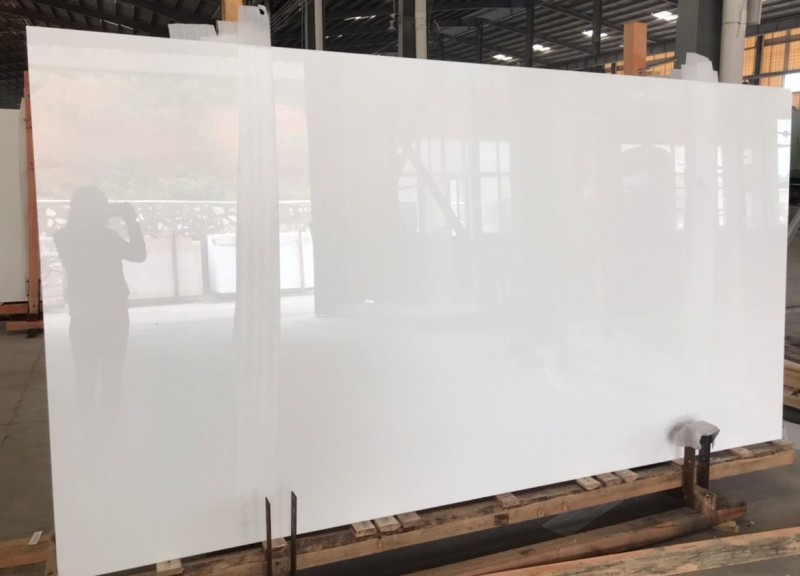
Crystallised glass and nano white marble slabs are produced by fusing silica-based glass materials under intense thermal conditions. They offer a non-porous, brilliant white finish with high chemical resistance.
| Material Type | Main Materials & Binders | Visual Character | Best Suited For | Main Considerations |
| Engineered Quartz | Quartz aggregate, resin binder | Veined, plain, or speckled | Kitchen worktops, vanities | Sensitive to direct thermal shock & strong UV exposure |
| Artificial Marble | Marble chips, resin/cement binder | Marble-look, soft veining | Internal flooring, wall cladding | Softer than quartz; requires careful spill management |
| Terrazzo | Marble/glass chips, polymer/cement | Distinctive speckled pattern | Retail interiors, feature walls | Cement-bound variants require proper surface sealing |
| Solid Surface | Mineral filler, acrylic/polyester resin | Uniform, plain, or subtle flecks | Reception desks, sanitary spaces | Can scratch easily; repairable via sanding |
| Porcelain / Sintered | Clays, feldspar, natural minerals | High-definition printed/through-body | Outdoor cladding, worktops | Requires specialised tooling and handling during fabrication |
| Nano / Crystallised Glass | Silica sand, glass minerals | Pure white, high-gloss finish | Vanities, sleek feature walls | Brittle edges during fabrication; requires expert cutting |
What Is Artificial Stone, and How Is It Made?
Artificial stone is a broad commercial term covering man-made stone slabs, engineered surfaces, agglomerates, and synthetic composites. These materials are manufactured by combining crushed natural aggregates, recycled glass, or mineral powders with a binding agent—typically organic resins or inorganic cementitious matrices. The mixture is compacted using intense pressure and vibration, cured under controlled thermal conditions, and calibrated into standardized slab thicknesses before receiving a final surface finish.
Because manufacturing techniques vary, the performance, thermal tolerance, and care protocols of man-made stone slabs differ significantly from product to product. Rather than relying solely on generic category names, trade buyers should evaluate each product’s specific material composition.
How to Choose the Right Artificial Stone Slabs
Selecting the ideal manufactured stone slab involves evaluating technical performance against project demands, budget constraints, and aesthetic goals.
Material Type and Composition
The choice of aggregate and binder determines how a slab reacts to environmental stressors:
- Resin-Bound Surfaces: Offer low porosity and excellent stain resistance, but organic resin binders can discolour under prolonged UV sunlight or degrade under extreme surface heat.
- Cementitious or Sintered Surfaces: Withstand higher thermal exposure and UV light, making them structurally suited for demanding external or high-temperature installations.
Pattern, Veining, and Colour
Manufactured stone slabs come in plain, speckled, veined, or marble-look designs:
- Through-Body vs. Surface Patterns: Through-body designs carry the pattern through the full slab thickness, ideal for exposed edge profiles. Surface prints rely on inkjet glazing technology, which requires careful edge treatment during fabrication.
- Batch Consistency: While man-made surfaces are more uniform than natural stone, minor tonal shifts occur between production runs. Always source all slabs for a single project area from the same production batch or lot number.
Thickness, Slab Size, and Layout
Selecting the correct dimensions optimizes material yield and reduces waste:
- Standard Thicknesses: Commonly available in 12 mm, 15 mm, 20 mm, and 30 mm. Thinner profiles (12 mm) are preferred for vertical wall cladding, while 20 mm and 30 mm profiles provide structural strength for kitchen islands and vanity tops.
- Jumbo Slabs: Standard and jumbo slab formats allow fabricators to execute expansive kitchen islands with minimal visible seams.
Finish
- Polished: Delivers a smooth, reflective surface that enhances colour depth and simplifies daily cleaning.
- Honed / Matt: Offers a satin, non-reflective appearance. Matt finishes show fewer light reflections but may require slightly more routine care to prevent grease marks.
- Textured / Bush-Hammered: Provides enhanced tactile structure and slip resistance, making it suitable for specialized commercial floors or accent walls.
Edges and Fabrication
At BBV Impex, we support client projects with bespoke fabrication services prior to export:
- Precise cut-to-size processing based on approved architectural drawings.
- Custom edge profiling, including pencil edge, bevel, half bullnose, full bullnose, and mitred apron edges.
- Book-matching arrangements for veined patterns and feature wall installations.
What Affects the Price per sqm
The price per square metre of artificial stone slabs varies according to several key parameters:
- Raw material quality and composition type (e.g., specialized sintered minerals vs. standard agglomerates).
- Complexity of the design, such as multi-layered veining versus basic plain colours.
- Slab thickness, overall dimensions, and surface finish treatment.
- Export crating method, freight insurance, customs tariffs, VAT, and local port clearance handling.
Artificial Stone vs. Natural Stone vs. Porcelain Slabs
Comparing surface categories helps specifiers align material selection with structural requirements:
| Performance Characteristic | Artificial Stone (Resin-Based) | Natural Marble / Stone | Porcelain & Sintered Stone |
| Look & Natural Variation | Controlled, repeatable patterns | Unique, natural geological variations | High-definition printed or full-body styles |
| Consistency Between Slabs | High uniformity across batches | Moderate to high shade variation | Very high consistency across production runs |
| Heat Tolerance | Moderate; requires trivets | Moderate; susceptible to thermal shock | Very high resistance to direct heat |
| Stain & Chemical Resistance | High resistance to non-abrasive spills | Porous; requires regular sealing | Exceptional resistance to stains & chemicals |
| Outdoor / UV Performance | Sensitive to UV discoloration | Suitable, depending on stone porosity | Excellent resistance to UV and frost |
| Scratch Resistance | High (quartz-based) to moderate | Varies; marble scratches easily | Very high scratch resistance |
| Repairability | Minor scratches can be buffed | Professional honing can restore finish | Hard to repair if chipped or cracked |
Best Uses for Artificial Stone Slabs
Kitchen Worktops and Islands
Artificial quartz and solid surface slabs are popular choices for residential kitchens and hotel kitchenettes. Their non-porous structure resists everyday liquid spills such as coffee, oil, and citrus juices.
Practical Consideration: Always use protective trivets under heated cookware, as direct thermal shock can scorch resin binders.
Bathrooms and Vanities
Engineered surfaces prevent moisture absorption, making them ideal for vanity tops, shower surroundings, and bath enclosures.
Practical Consideration: Ensure wall framing is structurally rated to handle the load of thicker slab cladding.
Wall Cladding and Feature Walls
Man-made stone slabs create striking feature walls in hotel lobbies, commercial corridors, and residential living areas.
Practical Consideration: Confirm mechanical anchor requirements and local building fire rating guidelines with your structural specifier before installation.
Flooring
Large-format agglomerate marble and terrazzo slabs provide durable flooring for retail stores, airports, and commercial halls.
Practical Consideration: Select a slip-resistant finish suitable for intended foot-traffic conditions.
Hotels, Retail, and Commercial Interiors
Consistency across production lots makes manufactured stone dependable for multi-room hotel fit-outs, restaurant counters, and retail reception desks.
Practical Consideration: Verify that cleaning staff use non-abrasive, pH-neutral maintenance chemicals.
Outdoor Use & Limits
While porcelain and cementitious slabs perform well outdoors, resin-bound artificial stones can yellow or warp under continuous direct sunlight and harsh thermal cycles.
Practical Consideration: Only use artificial stone outdoors if the specific product datasheet explicitly approves external UV exposure.
Checking Quality, Safety Information, and Documents Before Buying
Thorough pre-purchase verification ensures material compliance and smooth delivery.
Ask What It Is Made Of
Request full material safety details from your supplier. Confirm the exact aggregate type, binder system, and whether the material contains crystalline silica. Request an updated Safety Data Sheet (SDS) to evaluate safe handling protocols.
Samples and Batch Consistency
Always review physical samples rather than relying solely on digital screens. When placing orders for large surface areas, verify that all slabs are selected from the same batch or lot number to avoid shade variations across adjacent seams.
Test Reports and Declarations
Buyers can request independent third-party inspection certificates, physical property test reports, or technical declarations for density, water absorption, flexural strength, and abrasion resistance based on project specifications and regional regulatory standards.
Inspection Before Shipping and on Arrival
At BBV Impex, we provide high-resolution slab photos and video inspections of your selected bundles prior to dispatch. Upon arrival, inspect the crate packaging, check slab edges for transport damage, and verify batch numbers before initiating fabrication.
Fabrication, Installation, and Care
Fabrication Safety
Cutting, grinding, and polishing artificial stone slabs—particularly quartz-based surfaces—generates airborne dust containing hazardous particles. Fabricators must stringently adhere to national workplace health regulations by using wet-cutting equipment, integrated dust extraction systems, and certified respiratory protection equipment (RPE). Always consult the product’s Safety Data Sheet before processing.
Installation Basics
Successful installation requires experienced stone masons. Ensure sub-structures are level and fully supported. Seams should be positioned away from high-stress areas and executed using color-matched epoxy adhesives.
Heat, Sun, and Chemicals
- Use heat pads or trivets beneath pans, hot dishes, and cooking appliances.
- Avoid contacting resin-bound surfaces with harsh industrial solvents, paint strippers, or strongly alkaline cleaners.
- Protect indoor-rated slabs from direct sun exposure through window glazes or blinds.
Daily Care
Clean surfaces daily using a soft microfibre cloth, warm water, and a pH-neutral liquid detergent. Wipe up spills promptly, avoid metal scouring pads, and follow the manufacturer’s care guidelines.
Shipping Artificial Stone Slabs to Europe and the Middle East
BBV Impex exports engineered stone slabs directly to major ports and trade destinations across Europe, the GCC, and the broader Middle East.
Packaging, Crating, and Logistics
- Secure Bundles: Slabs are packed in fumigated wooden A-frames or sturdy wooden crates designed for ocean freight transport.
- Protection: Slabs are separated by protective film or plastic spacers to prevent face-to-face friction during transit.
- Incoterms: We offer flexible international shipping terms, including FOB, CIF, and DAP, based on client logistics preference.
- Documentation: Every export consignment includes a Commercial Invoice, Detailed Packing List, Certificate of Origin, and Bill of Lading (B/L).
Payment Terms
We follow transparent, secure international business payment practices:
- Advance Payment: A deposit is paid upon order confirmation, with the balance settled prior to shipment dispatch.
- Letter of Credit (L/C): We accept Irrevocable Letters of Credit at sight from tier-one international banks for bulk trade orders.
- Secure Banking Channels: Payments are routed securely via verified SWIFT / Telegraphic Transfer (TT) banking networks.
Ordering Process
- Enquiry: Submit your project dimensions, required slab type, pattern, and target quantities.
- Selection & Photos: Receive digital slab photos, batch details, and confirm sample approval.
- Quotation: Receive a formal export quotation covering material, crating, and shipping costs.
- Confirmation & Production: Confirm order details and issue advance payment or L/C.
- Quality Control & Dispatch: Review final pre-shipment photos and track your container shipment to your destination port.
Note: Customs clearance policies, import tariffs, local VAT rates, and timber packaging regulations vary by destination country. Buyers should confirm import requirements with a local customs broker.
FAQs
What are artificial stone slabs?
Artificial stone slabs are manufactured surfaces made by combining crushed aggregates (such as quartz, marble, or glass) with binders like resin or cement. The mixture is compressed, cured, and polished into standardized slabs for architectural use.
Is artificial stone the same as engineered quartz?
Engineered quartz is a specific type of artificial stone that utilizes quartz aggregate and resin binders. However, the artificial stone category also includes artificial marble, terrazzo, solid surface, porcelain, and nano glass surfaces.
Can artificial stone slabs be used outdoors?
Only specific formulations—such as porcelain, sintered stone, or cement-bound terrazzo—are designed for outdoor use. Resin-bound artificial stone slabs can fade or yellow under continuous UV sunlight and are recommended primarily for indoor applications.
Request Your Artificial Stone Slabs Quote Today
Whether you are sourcing bulk container loads for import or specifying worktops for a major commercial fit-out, BBV Impex provides dependable export services for high-quality artificial stone slabs. Request a Quote to receive competitive export pricing, or Order a Sample to verify our surface patterns and finishes firsthand.