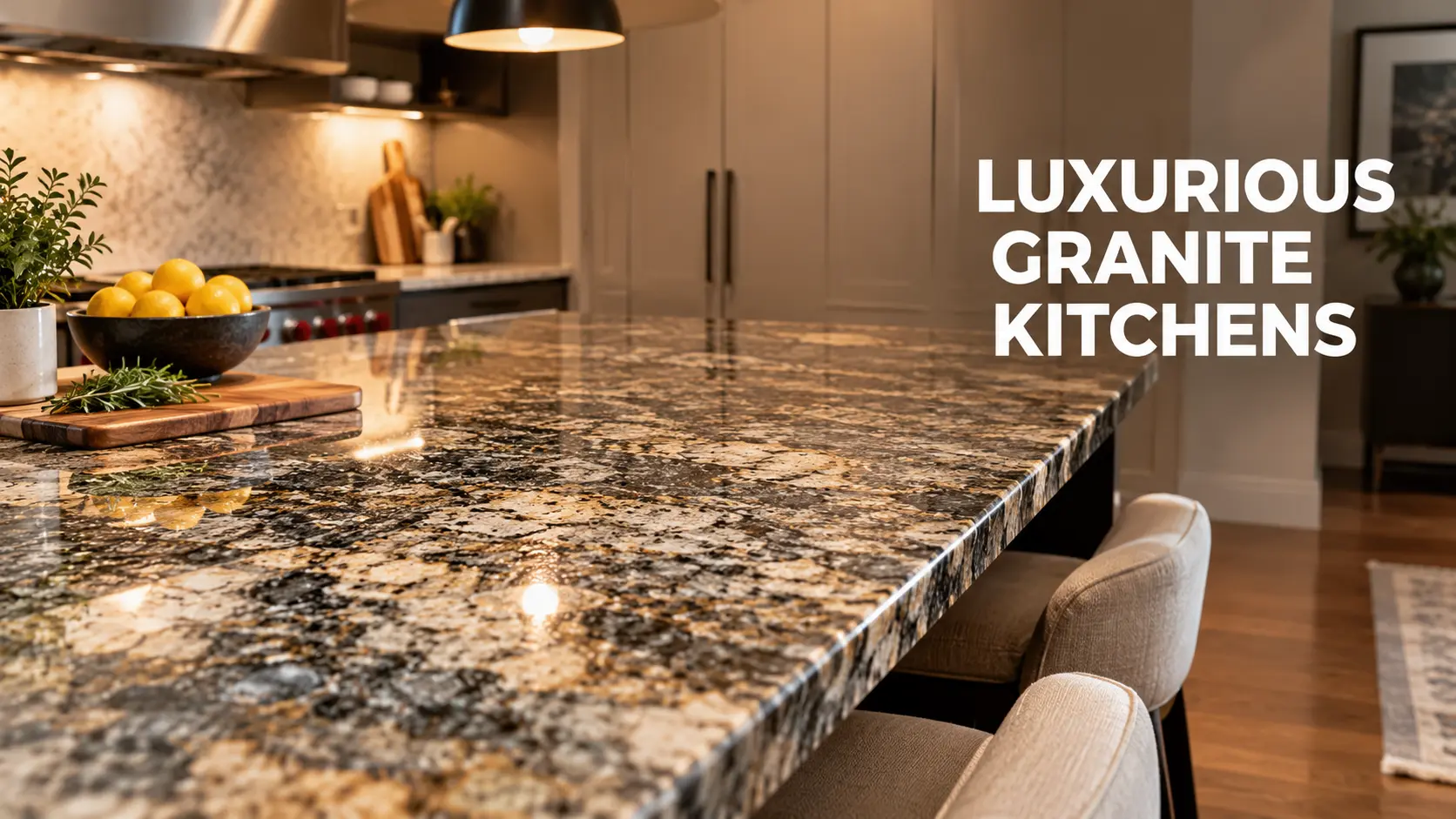

A high-end kitchen is rarely the result of simply choosing the most expensive materials on a showroom floor. True luxury in kitchen design comes from how a countertop interacts with the space around it. It is about how a heavy, dark slab grounds a room filled with natural light, or how the subtle, linear veining of a lighter stone pulls the eye across a massive central island. When homeowners and designers look at Indian granites for kitchens, they are looking for materials that offer architectural weight, visual depth, and intentional contrast. Choosing a natural stone is about finding the exact mineral structure, background tone, and finish that will make a specific combination of cabinetry and lighting feel cohesive and intentional.
What Makes a Granite “Kitchen-Luxury” Material?
The difference between a countertop that looks serviceable and one that reads as a luxury kitchen granite comes down to a few core visual and tactile elements. You have to consider how the raw material behaves once it is cut, finished, and installed in a residential environment.
Depth and Consistency of Color
Premium natural stone possesses visual depth. When you look down into the surface, the minerals should appear layered rather than flat. A high-quality slab maintains a consistent background tone from end to end. While natural variation is expected, luxury kitchens rely on a cohesive color story. If a slab shifts drastically in its base color from the left side to the right, it becomes incredibly difficult to place a seam without drawing the eye straight to the joint.
Contrast and Complement with Cabinetry
Luxury kitchens master the balance of visual weight. Heavy, dark granites demand light or brightly painted cabinetry to prevent the room from feeling cavernous. Conversely, a white or cream granite placed over dark walnut cabinets creates a sharp, tailored aesthetic. The stone must either deliberately contrast with the woodwork or perfectly complement it; middle-ground, low-contrast pairings often look muddy and unintentional.
Visual Weight of Grain and Speckle
The size of the minerals within the stone dictates its visual activity. Granites with tight, fine speckling read as solid colors from a distance, offering a subdued, modern look. Stones with large, sweeping veins or oversized mineral deposits command attention. In a massive kitchen with a double island, large-scale patterns thrive. In a smaller galley kitchen, that same oversized pattern can overwhelm the space, whereas a finer grain would make the room feel larger and more refined.
The Impact of Finish
A polished granite countertop is the traditional standard, offering a high-gloss, reflective surface that bounces light around the room. However, luxury design frequently utilizes alternative finishes. Honed (matte) finishes soften the stone, absorbing light and giving it a muted, sophisticated presence. Leathered finishes add physical texture, leaving a slightly undulating surface that feels incredibly premium to the touch while hiding fingerprints and smudges perfectly.
Lighting Interaction
How a stone reads is entirely dependent on your lighting plan. Warm under-cabinet lighting (around 2700K to 3000K) will pull the reds, browns, and golds out of a granite, making warm stones look richer. Cool daylight bulbs (4000K and above) enhance greys, blacks, and blues, making cool-toned slabs look crisp and architectural. Viewing slabs in the yard under direct sunlight is very different from viewing them inside your home.
Top 10 Indian Granites for a Luxurious Kitchen
When sourcing natural stone directly from India, these ten materials consistently deliver the depth, consistency, and structural beauty required for high-end residential projects.
Absolute Black
Absolute Black is a dense, exceptionally uniform stone with almost no visible grain from a distance. It offers a pitch-black background that absorbs the room’s palette, making it the ultimate anchor for a bright, modern kitchen. In a polished finish, it acts as a dark mirror, reflecting under-cabinet lighting and contrasting sharply with white, handleless cabinetry. When honed, Absolute Black takes on the soft, charcoal appearance of soapstone without the associated maintenance issues, making it highly sought after for minimalist and industrial luxury designs.
- Best paired with: Pure white, pale grey, or natural rift-sawn oak cabinetry.
- Recommended finish: Honed for modern spaces; polished for high contrast.
- Ideal edge profile: Simple eased or mitered edge to maintain clean lines.
Black Galaxy
Recognized instantly by its dark black background scattered with bright, copper-colored bronzite crystals, Black Galaxy brings dynamic texture to a dark surface. The metallic flecks catch the light as you move around the kitchen, adding a layer of visual interest that prevents the black surface from feeling flat. Because the visual draw is entirely dependent on light hitting those mineral deposits, this stone performs best under well-planned, direct overhead lighting.
- Best paired with: Walnut, dark cherry, or stark white cabinets.
- Recommended finish: Polished to maximize the reflectivity of the bronzite flecks.
- Ideal edge profile: Eased or half-bullnose to prevent distortion of the metallic flecks on the edge.
Colonial White
Colonial White provides a soft, warm off-white background mixed with pale greys and subtle clusters of dark red or burgundy garnets. It is a staple in high-end farmhouse and transitional kitchens because it reads as light and bright without the stark, clinical feel of a pure white artificial surface. The subtle warmth of the background ties in beautifully with natural wood accents and brass or unlacquered copper hardware.
- Best paired with: Cream, navy blue, or sage green cabinetry.
- Recommended finish: Polished to highlight the garnet inclusions, or leathered for a rustic tactile feel.
- Ideal edge profile: Ogee or full bullnose for traditional kitchen designs.
River White
Defined by its distinct, fluid linear movement, River White features a crisp white and light grey background with strong, flowing grey veins and deep red mineral spotting. This directional veining makes it an exceptional choice for large central islands, particularly those with waterfall panels, as the veins can be templated to flow continuously down the sides to the floor. It requires an experienced fabricator to ensure the seams align with the natural flow of the stone.
- Best paired with: Espresso, dark grey, or stark white cabinets.
- Recommended finish: Polished to emphasize the clarity of the grey veins.
- Ideal edge profile: Mitered drop-edge for thick-looking modern islands.
Viscount White
Viscount White is the solution for designers who want the aggressive, swirling drama of marble but require the heavy-duty resilience of granite. It features a high-contrast mix of white, grey, and deep black sweeping across the slab in unpredictable waves. Because the pattern is so bold and dominant, the stone acts as the primary piece of art in the kitchen. Surrounding elements should be kept relatively subdued to let the countertop command the room.
- Best paired with: Matte black or dark charcoal flat-panel cabinetry.
- Recommended finish: Polished for maximum contrast, or leathered to soften the dramatic movement.
- Ideal edge profile: Eased edge; complex profiles can interrupt the bold pattern.
Steel Grey
Steel Grey is a remarkably consistent, medium-to-dark grey stone with a subtle, low-contrast grain pattern consisting of lighter greys and subtle blues. While it looks excellent polished, Steel Grey truly enters the luxury category when given a leathered finish. The leathering process removes the softer particles of the stone, leaving a matte, highly tactile surface that feels sophisticated and organic. It is a highly forgiving color that hides dust, crumbs, and daily wear effortlessly.
- Best paired with: Light maple, stark white, or bold navy cabinets.
- Recommended finish: Leathered for a premium, tactile experience.
- Ideal edge profile: Eased edge to complement its modern, utilitarian aesthetic.
Thunder White
Thunder White offers a highly active, dynamic surface packed with tight grey, white, and cream minerals, often punctuated by deep burgundy or brown spotting. It is a busy stone, which is a significant advantage in kitchens that see heavy use, as the tight pattern acts as perfect camouflage for daily kitchen messes. The high density of the mineral structure gives it a crystalline depth that looks inherently expensive, especially over a large surface area.
- Best paired with: Dark brown wood or warm grey painted cabinets.
- Recommended finish: Polished to bring out the depth of the tight mineral clusters.
- Ideal edge profile: Beveled or half-bullnose to add dimension to the busy pattern.
Tan Brown
For heavy, traditional luxury, Tan Brown remains a formidable choice. It features a very dark brown, almost black background populated by large, prominent clusters of lighter tan and warm brown minerals. It has massive visual weight, making it the perfect capstone for heavy, intricately milled cabinetry. It grounds large, well-lit spaces and pairs naturally with heavy architectural elements like decorative corbels and oversized range hoods.
- Best paired with: Cherry wood, mahogany, or very light cream cabinets.
- Recommended finish: Polished to enrich the deep brown tones.
- Ideal edge profile: Ogee, Dupont, or French Cove for formal, traditional styling.
Ivory Fantasy
When a design calls for a soft, monolithic aesthetic, Ivory Fantasy delivers. It features a gentle blend of creams, light beiges, and subtle yellow undertones, with a cloudy, indistinct pattern. It does not demand attention; instead, it provides a warm, luminous horizontal plane that bounces natural daylight beautifully. It is a key ingredient in bright, airy, Mediterranean-inspired or high-end coastal kitchen designs where dark stones would feel too heavy.
- Best paired with: Antique white, cream, or light distressed wood cabinets.
- Recommended finish: Polished to maximize light reflection in airy spaces.
- Ideal edge profile: Bullnose or ogee to complement the soft color palette.
Vizag Blue
Vizag Blue is a distinct, polychromatic stone that shifts in appearance depending on the angle of the light. It features a deep, cool grey background overlaid with sweeping waves of muted blue and subtle purples. It is a statement stone, typically reserved for custom, architecturally driven homes where the homeowner wants a color that cannot be easily replicated by engineered quartz. It brings an undeniable bespoke quality to a kitchen island.
- Best paired with: Cool grey, stark white, or pale blue cabinetry.
- Recommended finish: Polished to highlight the blue color shift.
- Ideal edge profile: Eased or double-eased for a clean, structural look.
Choosing the Right Stone for Your Kitchen
Selecting the exact slab from a broad inventory when exploring imported and domestic stone options requires narrowing down your aesthetic goals.
First, look at your cabinet color. If you have chosen very dark cabinetry, a light stone like Colonial White or River White will provide the necessary contrast to prevent the kitchen from feeling like a cave. If your cabinets are pure white, a dark stone like Absolute Black or a heavily patterned stone like Viscount White will ground the design and provide a focal point. Matching wood tones to stone is trickier; always bring a cabinet door sample to the stone yard to ensure the undertones in the wood do not clash with the undertones in the granite.
Next, consider the countertop edge style. Intricate edges like an Ogee or a Dupont look highly luxurious on traditional stones like Tan Brown or Ivory Fantasy. However, on heavily veined stones like Viscount White, a complex edge profile will chop up the natural movement of the veins. For modern luxury designs, a thick, mitered drop-edge (where two pieces of stone are joined at a 45-degree angle to look like a single massive block) works exceptionally well with linear stones like River White.
Finally, be honest about the size of your kitchen. Bold, highly active patterns require square footage to stretch out. In a small kitchen, a massive swirling pattern will be cut into too many small pieces by the sink and stove cutouts, making the room feel chaotic. Smaller kitchens benefit greatly from the refined, consistent grain of Steel Grey or Absolute Black, which provide luxury without overwhelming the limited space.
Frequently Asked Questions
Absolute Black and Steel Grey offer striking, modern contrast against white cabinets, while Colonial White provides a softer, tone-on-tone transitional look.
Dark granite can make a room feel closed in if the kitchen lacks adequate natural light and is paired with dark flooring or cabinetry, but it looks incredibly sharp when heavily contrasted with bright, white surroundings.
Polished granite is generally easier to clean and better at resisting stains, but honed granite offers a premium, tactile, matte look that many luxury homeowners prefer, provided they keep up with regular sealing.
A high-quality granite slab will have a consistent structural integrity without severe natural fissures, a uniform polish across the entire surface without dull spots, and a clear, distinct mineral pattern rather than a muddy or blurred appearance.
Yes, most granites are highly resistant to UV fading and temperature fluctuations, making stones like Steel Grey and Absolute Black excellent choices for outdoor barbecue and kitchen setups.
Lighter stones like River White and Colonial White generally require sealing once a year to prevent staining, while very dense dark stones like Absolute Black rarely need sealing at all.
Moving Forward with Your Project
Building a luxurious kitchen requires selecting a countertop material that perfectly balances color, texture, and visual weight. The top Indian granites for kitchens offer a spectrum of design possibilities, from the stark, modern appeal of Absolute Black to the flowing, architectural drama of River White. Because natural stone varies from bundle to bundle, the name of the stone is just the starting point. To ensure you get the right look for your home, always request high-resolution slab photos of the current inventory for your shortlist. Reach out to your local granite slab supplier to check stock availability in your preferred colors, and always request a physical sample to view in your kitchen’s actual lighting before making your final decision.