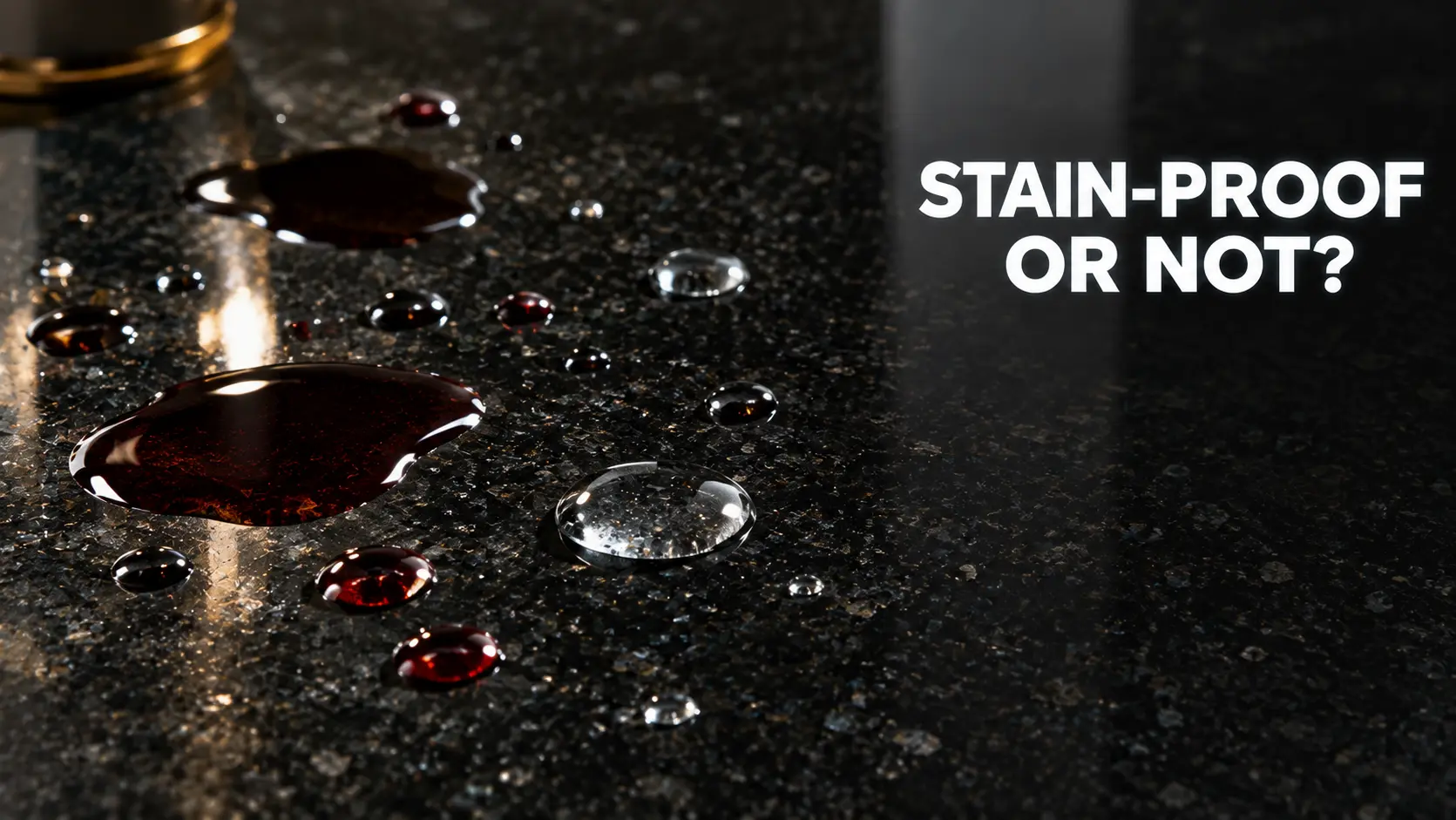

If you are researching materials for a new kitchen, you have likely heard a very common claim from salespeople and designers alike. They will tell you that dark, dense stones are completely impervious to daily wear and tear. Buyers constantly ask us if Absolute Black Granite is truly stain-proof before making their final decision.
The honest, straightforward answer is no. No natural stone on earth is entirely immune to absorbing liquids under every possible circumstance, which means the literal “stain-proof” label is a myth. However, when you look closely at the natural properties of [this deeply colored, tightly grained natural stone], you will find that it is incredibly stain-resistant.
Understanding the actual behavior of this material will help you make a confident, informed purchase. Let’s look at the science of granite porosity, what happens when a spill occurs, and what it actually takes to leave a lasting mark on your counters.
Stain-Proof vs. Stain-Resistant: What’s the Real Difference?
Words matter when you are selecting a surface that will see daily food preparation for decades. A stain-proof material would mathematically absorb zero moisture, regardless of how long a spill sat on the surface. Some synthetic materials attempt to reach this standard, but natural stone behaves differently because it is an organic, porous material born from the earth.
This brings up the highly debated question: is granite stain resistant? The answer to that is a resounding yes. Stain resistance simply means the stone provides a generous window of time to wipe up a spill before it penetrates the surface.
When homeowners ask, “does granite stain?”, they are usually picturing a ruined countertop after a single dropped glass of wine. In reality, a highly resistant stone acts as a shield, holding the liquid on the surface long enough for you to grab a towel. You are buying time and durability, not an invincible forcefield.
Why Absolute Black Granite Resists Stains So Well
To understand Absolute Black Granite pros and cons, you have to look at how the stone was formed underground. Granite is an igneous rock, meaning it was forged under extreme heat and pressure over millions of years. This violent natural process packs the mineral crystals very tightly together.
Because the internal structure is so compressed, the stone has an exceptionally low natural stone porosity. There is very little empty space between the crystals for liquids to seep into. When you browse [heavy-duty rock surfaces for the kitchen], you will notice that darker stones generally possess denser structures than their lighter counterparts.
The finish you choose also plays a massive role in this resistance. A highly polished slab has been buffed by heavy friction pads, which effectively tightens the surface pores even further. A honed (matte) finish leaves the pores slightly more open, meaning it will absorb liquids slightly faster than a polished surface if left completely unprotected.
What Can Actually Stain Absolute Black Granite?
Despite its rugged nature, black granite countertop stains are a real possibility if the stone is neglected. Because the stone is naturally black, traditional culprits like red wine, coffee, or tomato sauce rarely leave a visible color mark. Instead, the real enemies of dark granite are oils and unsealed surfaces.
Cooking Oil and Grease
Oil-based liquids are the single biggest threat to dark, dense stones. If cooking oil, melted butter, or bacon grease is left sitting on the counter overnight, it can seep into the micro-pores. Because oil naturally darkens stone, this creates a shadow or a “wet spot” that will not evaporate on its own.
Acidic Spills and Hard Water
While acids won’t necessarily stain the stone, they can cause visual damage that looks exactly like a stain. Prolonged contact with lemon juice or vinegar can degrade the protective sealant, leaving the raw stone vulnerable to the next spill. Additionally, hard water left to dry around a sink faucet will leave stubborn white mineral deposits that strongly contrast against the black background.
The Unsealed Slab Problem
Almost all staining issues occur when a granite slab is left unsealed or when the sealant has worn away from years of heavy use. An unprotected surface relies entirely on its natural density to fight off moisture. While Absolute Black is dense enough to survive brief spills unsealed, long-term exposure to daily cooking messes will eventually catch up with it.
Granite vs. Marble Staining: A Quick Reality Check
Many buyers get confused by conflicting advice because they lump all natural stones into a single category. The granite vs marble staining conversation perfectly illustrates why this is a mistake. If you compare our dark granite to something like Indian Statuario Marble, the behavioral differences are night and day.
Marble is a softer, calcium-based metamorphic rock with a much higher porosity. It eagerly absorbs liquids, and its calcium makeup reacts violently to acidic foods, causing permanent dull spots known as etching. In contrast, the dense quartz and feldspar makeup of Absolute Black Granite ignores acids and repels liquids long enough for easy cleanup.
Even within the same geological family, slight variations exist among [premium materials sourced directly from the subcontinent]. For instance, Black Galaxy Granite shares the incredible density of Absolute Black, but its natural copper flecks easily hide dust and water spots. Absolute Black’s pure, uniform darkness requires a bit more daily wiping simply because it acts like a mirror for crumbs and smudges.
Sealing Granite Countertops: How Often Do You Need It?
Proper sealing is the ultimate secret to maximizing your granite stain resistance. A high-quality impregnating sealer does not coat the stone in a shiny plastic shell. Instead, it sinks into the microscopic pores and clogs them from the inside, blocking out foreign liquids.
Sealing granite countertops is an incredibly simple process that takes about twenty minutes once a year. You simply wipe the liquid sealer onto the clean stone, let it absorb, and buff away the excess. Because Absolute Black is so naturally dense, it actually requires far less sealer than lighter granites because there is less empty space to fill.
You do not have to guess when your counters need a fresh coat of protection. Just drip a tablespoon of regular tap water onto the most heavily used section of your counter and wait ten minutes. If the water beads up like rain on a freshly waxed car, your seal is perfect; if the water spreads and darkens the stone beneath it, it is time to reseal.
Practical Maintenance Checklist for Absolute Black Granite Countertops
Knowing how to clean granite countertops correctly will prevent the vast majority of surface issues. Routine Absolute Black Granite maintenance is mostly about consistency rather than heavy scrubbing. Follow this straightforward routine to keep your kitchen surfaces completely safe.
- Wipe spills immediately: Never let cooking oil, wine, or citrus juices sit on the counter overnight.
- Use the right cleaner: Stick to mild dish soap and warm water, or a dedicated pH-neutral stone cleaner.
- Ban harsh chemicals: Never use bleach, ammonia, glass cleaners, or vinegar, as these strip away your protective sealant.
- Use coasters and trivets: While the stone is heat-resistant, keeping oil bottles and hot pans off the bare surface prevents accidental grease rings.
- Dry around the sink: Wipe away standing water near faucets to prevent white mineral crusts from forming.
- Perform the water test: Check your sealant every six to twelve months using the simple water-bead test described above.
Frequently Asked Questions (FAQ)
Yes, it absolutely requires sealing to protect against oil and grease absorption. While it is naturally denser than many other stones, a quality impregnating sealer is your primary defense against permanent dark spots.
You can tell by doing a simple water-bead test on the surface. Pour a small amount of water on the counter; if the stone darkens and absorbs the water within ten minutes, the sealant has worn off.
No, you should never use vinegar on natural stone surfaces. The high acidity in vinegar will quickly break down your protective sealant and leave the stone vulnerable to real stains.
A baking soda and water poultice is the most effective method for drawing out deeply absorbed oil. You apply the thick paste over the stain, cover it with plastic wrap, and let it sit for 24 hours to pull the oil out of the pores.
They are easy to sanitize but do show dust, fingerprints, and water spots more clearly than lighter stones. You will likely need to wipe them down daily with a microfiber cloth to keep them looking pristine.
The Verdict on Absolute Black Granite Kitchens
The “stain-proof” label might be an exaggeration, but Absolute Black Granite remains one of the safest, most durable investments you can make for a high-traffic home. Its dense geological structure provides incredible natural resistance to the spills, splashes, and accidents that happen in every busy kitchen.
When properly sealed and cleaned with mild products, this stone easily handles everything from spilled wine to everyday meal prep. You just have to treat it like a natural, porous material rather than an indestructible sheet of metal. A little daily care ensures the deep, elegant color lasts for generations.
If you are ready to see how this beautiful material behaves in person, we are here to help. Contact us today to ask about our current sealing recommendations, request a physical sample to test at home, or get a comprehensive quote for your upcoming project.