


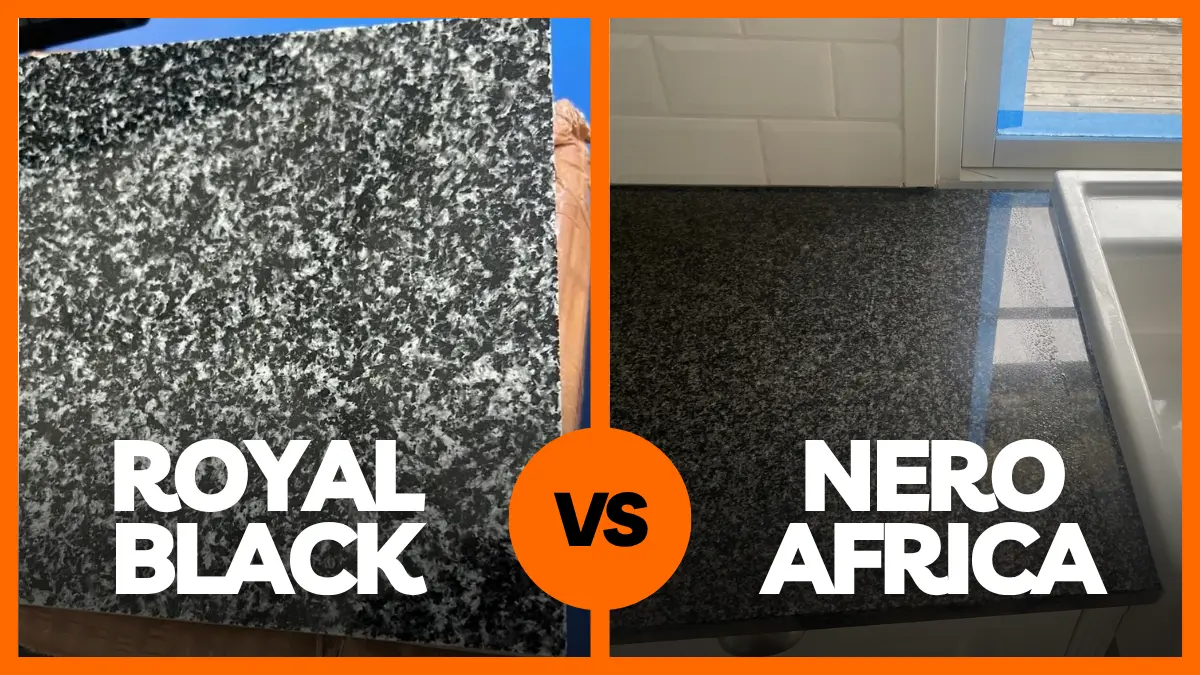

Selecting the right dark natural stone slab involves much more than picking a color. When comparing Nero Africa Impala Granite vs Royal Black Granite, buyers are actually choosing between two distinct mineral structures that behave differently during fabrication, installation, and daily use. Both materials are highly durable igneous stones, but their grain patterns, batch consistency, and finish reactions dictate where they perform best.
Specifying the wrong material can lead to visible seams on a kitchen island, mismatched panels on a commercial facade, or heavy maintenance burdens in high-traffic flooring. This black granite comparison breaks down the visual characteristics, environmental performance, and fabrication realities of both stones to help you make an informed sourcing decision.
Visual Profiles: Grain, Speckle, and Color Depth
The most immediate difference between these two imported granite slabs is their visual texture. How the grain reads at close range versus from a distance dictates how the stone integrates into an architectural palette.
Nero Africa Impala Granite: Uniform and Speckled
Quarried in South Africa, Nero Africa Impala Granite—often traded simply as Nero Impala granite—is technically classified as a norite or gabbro. It features a medium-to-fine grain structure heavily populated with light grey, silver, and white speckles against a charcoal base.
From a distance of a few meters, this speckled black granite blends into a uniform, soft dark grey. Up close, the mineral pattern is highly consistent across the slab. This lack of directional veining means the stone lacks “movement,” which is actually a massive advantage for large-scale projects requiring strict visual uniformity.
Royal Black Granite: Deep, High-Contrast Jet Black
Royal Black Granite is a premium Indian black granite known for its intense, deep black background. Depending on the specific quarry block, the surface is sparsely populated with tiny crystalline deposits or subtle grey micro-flecks.
Unlike the soft charcoal read of Impala, Royal Black delivers a true, stark black visual. The high contrast between the dark matrix and the occasional reflective mineral inclusions gives the stone visual depth. It provides a more dramatic aesthetic, absorbing light deeply while offering subtle crystalline reflections under direct illumination.
Nero Africa Impala Granite vs Royal Black Granite: Side-by-Side Comparison
When consulting with a black granite slab supplier, use this technical breakdown to match material characteristics to your project parameters.
| Feature | Nero Africa Impala Granite | Royal Black Granite |
| Appearance & Grain | Fine-to-medium speckle; uniform distribution | Jet black base with sparse micro-crystalline flecks |
| Color Depth | Charcoal / dark grey-black | Deep, solid jet black |
| Typical Finishes | Polished, honed, flamed, bush-hammered | Polished, leathered, honed, flamed |
| Best-Suited Applications | Exterior cladding, commercial flooring, heavy traffic areas | Luxury countertops, feature walls, monuments |
| Fabrication & Seams | Very easy to color-match; epoxy seams hide easily | Clean cutting; requires precise edge polishing |
| Batch Consistency | Exceptionally high block-to-block consistency | Good, but background darkness can vary by quarry |
| Maintenance Needs | Very low; speckled pattern hides dust and spots | Moderate; pure black shows dust and fingerprints |
| Design Style Fit | Industrial, brutalist, functional commercial | High-contrast modern, traditional luxury, minimalist |
How Surface Finishes Change Color and Performance
A granite slab’s finish fundamentally alters its color perception and practical application. Dark granite responds dramatically to surface processing.
Polished and Honed Finishes for Interiors
A polished black granite surface deepens the color of the stone, acting like a mirror that highlights the internal mineral structure. On Royal Black, polishing creates a striking, reflective jet-black surface ideal for luxury interiors. On Nero Impala, the polish accentuates the silver speckling, keeping the stone looking slightly lighter.
Honed black granite offers a matte, unreflective surface that softens the visual weight of the stone. Honing Royal Black pulls it slightly toward a dark charcoal, while honed Nero Impala takes on the appearance of dark concrete or slate. Honed finishes are excellent for interior flooring as they provide better slip resistance than polished slabs.
Flamed and Leathered Finishes for Exteriors and Texture
A flamed black granite finish is achieved by exposing the slab to intense heat, causing the surface crystals to pop. This creates a rough, highly textured face that is mandatory for exterior paving and pool coping. Flaming significantly lightens the color of both stones, turning Nero Impala into a medium-grey and Royal Black into a textured charcoal.
Leathered finishes involve brushing a honed or flamed surface with diamond-tipped brushes. This creates a tactile, slightly undulating surface that retains the dark color depth better than flaming. Leathered black granite countertops are highly sought after because the texture naturally disguises fingerprints, water rings, and daily smudges.
Climate, Environment, and Long-Term Durability
Natural stone must respond to the local climate. Both of these granites boast dense mineral structures, but local environmental stressors should dictate your finish and installation methods.
- Freeze-Thaw Cycles (Northern & Eastern Europe): Both stones have inherently low porosity, meaning they do not absorb significant moisture. This makes them highly resistant to spalling or cracking during severe winter freeze-thaw cycles in regions like Poland, Germany, or Ukraine.
- Intense UV and Heat (Gulf and North Africa): Dark stones absorb solar radiation. When using granite for exterior cladding in Saudi Arabia or Libya, engineers must account for thermal expansion. Ventilated facade systems with mechanical anchors allow the slabs to expand without stressing the joints.
- Coastal Salt Exposure (Mediterranean and Islands): The dense igneous nature of both stones resists salt-air pitting. However, polished finishes may dull over decades of direct coastal wind abrasion, making honed or flamed finishes more practical for seaside exteriors.
- High Humidity (Southeast Asia): In places like Singapore or Vietnam, exterior stone can attract algae or mildew. A proper penetrating impregnator sealer prevents organic growth from taking hold within the micro-pores of the stone.
Fabrication Considerations: Yield, Seams, and Sourcing
Fabricators look at natural stone slabs differently than designers do. Workability, slab dimensions, and batch matching directly impact project margins and lead times.
Granite Slab Thickness and Edge Profiles
When ordering from a supplier, consider your required granite slab thickness. Standard 20mm and 30mm gangsaw slabs are typical for kitchen and vanity applications. For heavy commercial treads or monuments, cut-to-size cutter slabs or raw blocks are required.
Both stones machine exceptionally well on bridge saws and CNC routers. Royal Black’s dense matrix holds sharp, intricate edge profiles—like ogee or deep miters—without crumbling. Nero Impala cuts just as cleanly, though its speckled nature makes complex edge routing visually softer.
Managing Seams and Batch Variation
Seam visibility is a major concern for fabricators. Nero Africa Impala is highly forgiving; its tight speckled pattern acts like visual camouflage, making tight epoxy seams nearly invisible on long countertop runs.
Royal Black requires more care. Because the background is solid black, a seam breaking a continuous polished surface catches the eye more easily. Furthermore, while Nero Impala is famous for massive block-to-block consistency, Royal Black can exhibit slight variations in background darkness between quarry batches. Always approve the specific batch before fabricating large runs.
Which Black Granite Is Best for Your Specific Application?
Choosing the best black granite for countertops or facades requires matching the stone’s physical traits to the daily realities of the space.
Kitchen Countertops and Islands
If you are designing a high-contrast space featuring white cabinetry, warm walnut woods, or brass fixtures, Royal Black Granite provides the crisp, solid baseline required. It is an exceptional choice for modern minimalist kitchens.
However, solid black polished surfaces show dust, crumbs, and fingerprints immediately. If the kitchen sees heavy daily use, Nero Africa Impala is the more practical choice. The grey-black speckled pattern naturally hides daily messes, reducing black granite maintenance and the need for constant wiping.
Exterior Facades and Wall Cladding
For exterior commercial architecture, Nero Africa Impala Granite is usually the superior choice. When cladding a multi-story building, you need hundreds of slabs that look identical. Impala’s exceptional batch consistency ensures that panels quarried months apart will still match perfectly on the building face.
Furthermore, the charcoal-grey tone of Nero Impala pairs naturally with industrial materials like exposed steel, glass, and raw concrete. Black granite wall cladding using Royal Black is certainly possible, but securing enough identically toned material for a massive facade requires strict, upfront block reservation.
Interior Flooring, Staircases, and Commercial Lobbies
In retail environments, hotel lobbies, and corporate reception areas, flooring takes a beating from foot traffic and abrasive shoe grit. Polished Royal Black flooring will show micro-scratches and dust quickly in these environments.
Nero Impala is the industry standard for high-traffic dark flooring. A honed or brushed Impala tile hides scuffs and dirt effortlessly, allowing maintenance teams to maintain a clean appearance with standard nightly sweeping and mopping.
Monuments, Headstones, and Memorials
The memorial industry relies heavily on both materials. Black granite for monuments requires a dense structure that takes laser etching and sandblasting well.
Royal Black Granite is highly prized by monument workshops because the pure black background creates extreme contrast when letters or images are engraved into the lighter underlying stone. Nero Impala remains a traditional, highly respected choice across European memorial markets, offering a dignified, softer charcoal appearance that weathers beautifully over decades.
Frequently Asked Questions
Which stone is darker, Nero Africa Impala or Royal Black Granite?
Royal Black Granite is significantly darker, featuring a deep jet-black background, whereas Nero Africa Impala reads as a dark charcoal or grey-black due to its heavy silver speckling.
Do these black granites need to be sealed?
Yes, both stones should be treated with a high-quality penetrating sealer upon installation to prevent oils and liquids from migrating into the micro-pores.
Is speckled black granite easier to keep clean?
Yes, a speckled pattern like Nero Impala visually breaks up the surface, effortlessly hiding dust, dried water drops, and fingerprints that would stand out on a solid black slab.
Can I use a flamed black granite finish outdoors?
Yes, flaming the surface creates a highly textured, slip-resistant finish that is incredibly durable for outdoor paving, pool coping, and exterior stair treads.
How do seams look on dark granite installations?
Epoxy seams are generally less visible on dark stones than light stones, but the speckled grain of Nero Impala hides joint lines much better than the solid background of Royal Black.
Making Your Final Selection
The decision between Nero Africa Impala Granite and Royal Black Granite comes down to consistency versus contrast.
Specify Nero Africa Impala Granite when your project demands absolute uniformity across large areas, forgiving daily maintenance, and a softer charcoal aesthetic. It is the workhorse stone for commercial flooring, expansive exterior cladding, and high-traffic residential surfaces.
Choose Royal Black Granite when visual impact is the primary goal. Its deep, rich jet-black tone provides unparalleled contrast for luxury kitchen islands, executive bathroom vanities, and striking architectural feature walls.
Before finalizing your specification, seeing the current quarry batch is crucial. Reach out to our team to request high-resolution slab photos of our current inventory. You can also share your architectural drawings for a custom cut-to-size quote, or order physical samples to test against your project’s lighting and material palette.
