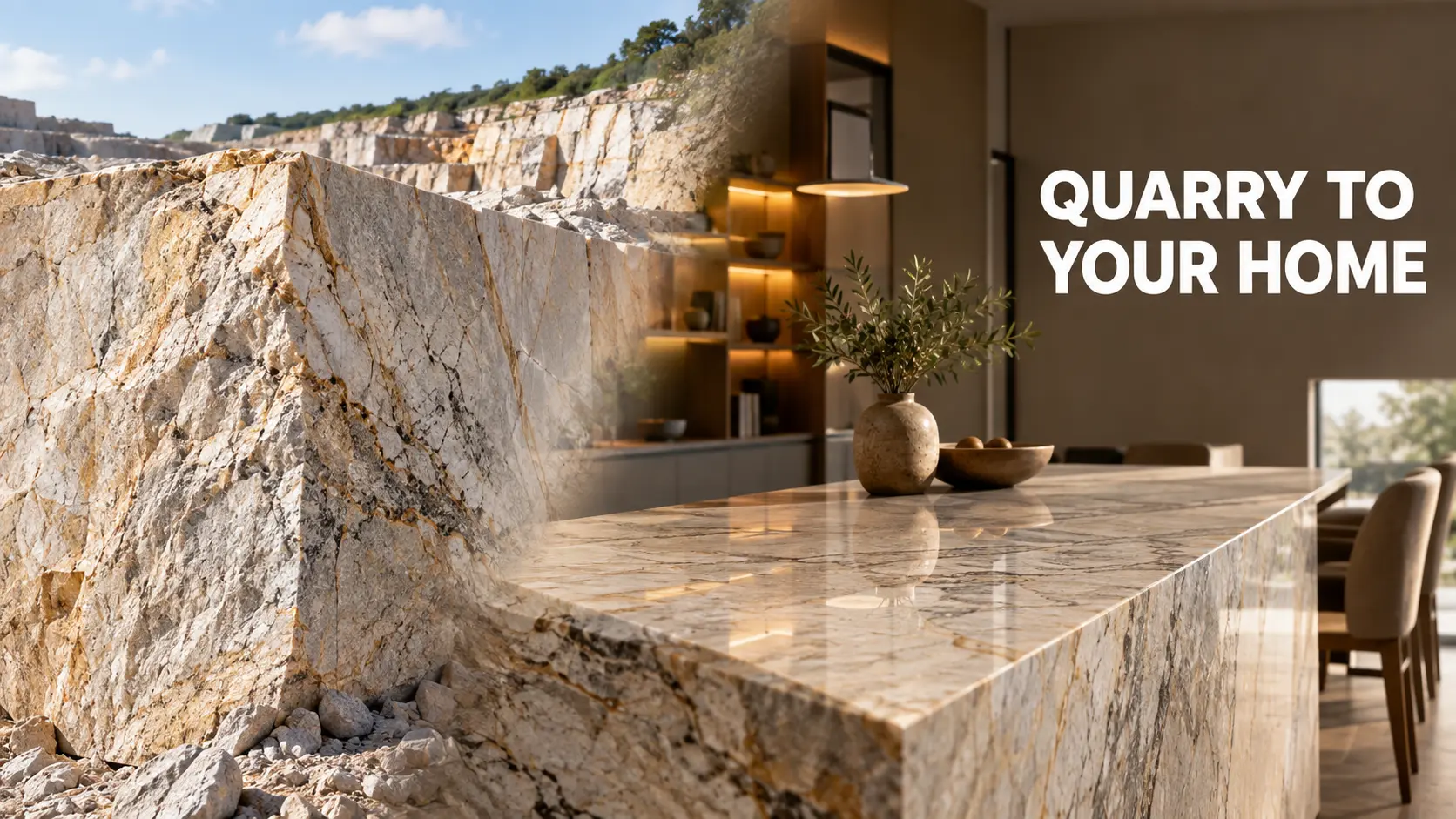

The polished marble worktop in a London townhouse or the honed limestone floor in a Munich villa did not begin its life in a modern factory workshop. Millions of years ago, deep within the Earth’s crust, intense heat and tectonic pressure began shaping the organic veining, mineral deposits, and subtle tones we see today. Bringing natural stone into a home connects modern interior design directly with geological history.
Between the raw mountain face and your finished kitchen island lies an extraordinary process governed by trade heritage, heavy engineering, and precise craftsmanship. Understanding how stone travels from a quarry to your living space helps you choose the right material, surface finish, and fabrication method for your project.
Deep Origins: How Natural Stone Forms Underground
Every slab carries a physical record of the environmental conditions present during its formation. Geologists divide these structural rocks into three distinct categories:
Igneous Stone
Formed as molten magma cools and solidifies deep underground, igneous rocks are dense and durable. Granite is the most recognisable example, prized for its high scratch resistance and low porosity. Another striking igneous choice is Norwegian Larvikite, famous for its iridescent blue feldspar crystals that shimmer when light strikes the surface.
Sedimentary Stone
Formed over millennia as organic shell fragments, sand, and mineral sediment settle under ocean beds or lake basins, sedimentary stone features soft tonal variations and fossilised detail. Popular European options include:
- Limestone and Travertine: German Jura limestone with its visible marine fossils, Belgian Blue stone (Pierre Bleue), Irish blue limestone, French Burgundy limestone, and Portuguese Moleanos.
- Sandstone: English Bath stone, Yorkstone, and Portland stone, which have defined classic British architecture for centuries.
Metamorphic Stone
Metamorphic rocks begin as sedimentary or igneous stone before undergoing massive heat and geological pressure, causing their mineral structure to recrystallise.
- Marble Slabs: Renowned metamorphic stones include white Carrara, Calacatta, and Statuario from the Apuan Alps in Tuscany, Spanish Macael marble, Greek Thassos and Volakas, and Portuguese Estremoz.
- Quartzite Slabs: Quartzite forms when quartz-rich sandstone undergoes high heat and pressure, yielding a material that rivals granite in hardness while offering the delicate veining of marble.
- Slate: Metamorphic slates, such as Welsh, Cumbrian, and Galician slate from north-west Spain, split naturally into thin sheets, making them ideal for roofing, hearths, and flooring.
Inside the Natural Stone Quarry: Extraction and Sustainability
Extracting raw material from a natural stone quarry requires exceptional precision to preserve the integrity of the rock face. Historical methods relied on explosive blasting, which created internal fractures and significant material waste. Modern European quarries use advanced diamond wire saws, high-pressure waterjets, and hydraulic splitters to carve massive blocks cleanly from the mountain side.
Understanding how natural stone is quarried reveals why production varies by region. Workers isolate a vertical mountain face before threading diamond-coated steel wire through drilled guide holes. Driven by continuous flywheel systems, the wire slices smoothly through the stone. Hydraulic bags or splitting cylinders then gently push the raw stone block—often weighing between 20 and 30 tonnes—onto a bed of soft gravel.
Sustainable stone sourcing is now standard practice across European quarries. Strict EU environmental directives require quarry owners to manage water recycling systems during cutting, control dust emission, and restore decommissioned quarry landscapes back to natural habitats or public recreation areas. Because stone is processed mechanically rather than synthesized chemically, its embodied carbon footprint compares favourably with man-made surfaces when sourced locally within Europe.
From Raw Block to Slab: Processing and Finishes
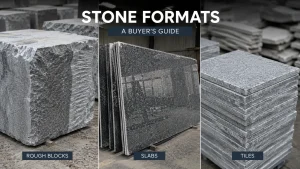
Once extracted, raw blocks travel by heavy transport to nearby processing plants. Here, large gang saws or multi-wire cutting machines slice the block into uniform natural stone slabs, typically cut to standard European thicknesses of 20mm or 30mm.
To stabilize fragile stones or intricate marble veining, technicians apply a fine coat of epoxy resin paired with a glass-fibre mesh backing to the rear of the slab. This vacuum-assisted treatment seals micro-fissures without obscuring the stone’s natural pattern.
Selecting Surface Finishes
The mechanical finish applied to a slab alters both its appearance and practical performance:
| Finish | Surface Texture | Visual Effect | Best Application & Regional Suitability |
| Polished | Smooth, highly reflective | Enhances color depth and veining clarity | Internal splashbacks, feature walls, bathroom vanities. Requires care in high-traffic or wet areas. |
| Honed | Smooth, matte or satin | Soft, contemporary look that disguises wear | Natural stone kitchen worktops, high-use hallway floors, hard-water bathroom areas across Central Europe. |
| Brushed | Lightly textured, soft feel | Gentle, worn patina that follows stone grain | Living room flooring, hearths, rustic kitchens, indoor-outdoor transitional spaces. |
| Flamed | Rough, textured, anti-slip | Weathered, rustic appearance | External natural stone paving, pool surrounds, terraces in Nordic and Alpine freeze-thaw climates. |
| Bush-Hammered | Coarsely dimpled | Uniform, highly slip-resistant | Public steps, external natural stone cladding, heavy-duty outdoor walkways across wet Atlantic regions. |
Logistics and the Route to European Slab Yards
After processing, slabs are arranged into sequential sets called bundles. Keeping consecutive slices from the same block together is essential for book-matched slabs, where two adjoining slabs mirror each other’s veining across large kitchen islands or wet room walls.
The slabs then travel via sea container or freight lorry to distribution hubs across Western, Northern, and Eastern Europe. A specialized natural stone supplier in Europe maintains dedicated slab yards serving major metropolitan markets like London, Paris, Milan, Berlin, Amsterdam, and Warsaw.
When specifying material for construction use within the EU and UK, ensure the stone carries valid CE or UKCA marking. These marks confirm the product complies with harmonised European standards (EN standards for natural stone products), providing certified testing for performance characteristics like water absorption, flexural strength, and slip resistance.
Practical Slab Selection for European Homes
Visiting a slab yard in person is an essential step in slab selection. Because stone is a natural product, small sample swatches rarely show the full variation, movement, and inclusions present across a full 3-metre slab.
Matching Stone to Your Space and Climate
Different rooms and regional environments require specific stone characteristics:
- Kitchen Worktops and Islands: Quartzite slabs and dense granites offer superior heat and scratch resistance for active kitchens. If you prefer the look of European marble or limestone, choose a honed finish; matte surfaces disguise the minor etching caused by acidic foods like lemon juice or wine.
- Bathrooms and Wet Rooms: Hard water in many European regions creates limescale build-up. Honed marble or Portuguese limestone performs better than high-gloss polished surfaces in damp environments, as light cleaning will not dull the finish.
- Flooring Over Underfloor Heating: Stone is an exceptional conductor of thermal energy. Natural stone flooring laid over hydronic underfloor heating holds heat for long periods, providing efficient warmth through northern winters. Always specify an uncoupling membrane to prevent subfloor movement from cracking the tiles.
- Terraces, Paving, and External Cladding: Outdoor natural stone paving in Alpine or Scandinavian climates must resist seasonal freeze-thaw cycles. Select frost-resistant stones with low water absorption, such as Norwegian Larvikite, Spanish slate, or Yorkstone, finished with a flamed or bush-hammered surface for slip safety when wet.
Natural Stone vs Engineered Quartz
While engineered quartz and porcelain offer uniform patterns, natural stone vs engineered quartz remains a common design debate. Engineered surfaces use resin binders that can scorch under hot pans and lack the unique mineral depth created by millions of years of geological growth. Authentic stone can also be re-polished, repaired, and restored decades after installation, making it a sustainable choice for long-term home ownership.
Templating, Fabrication, and Installation Day
Once you select your material, the natural stone fabrication process turns raw slabs into precise architectural elements for your home.
- Digital Templating: Once kitchen cabinets, bathroom plinths, or subfloors are fully installed and leveled, a fabricator uses digital laser scanners to capture the exact layout, including wall irregularities and cutouts for taps and sinks.
- Layout and Seam Planning: The fabricator overlays the digital templates onto high-resolution photos of your chosen slabs. This step plans seam placement and ensures continuous stone veining and movement across splashbacks, mitred edges, and waterfall ends.
- Precision Cutting: CNC bridge saws and waterjets cut the slabs to size. Edge profiles—from simple pencil edges to classic double-Ogee details—are shaped and polished using diamond tooling.
- Natural Stone Installation: The fabricator’s installation crew delivers the cut stone to your home. They level the pieces, secure joints with colour-matched epoxy seams, seal cutouts around taps and hobs, and apply an initial protective sealer.
Care, Sealing, and Living with Stone
Maintaining natural stone is straightforward when you understand its basic physical properties.
Sealing Natural Stone
Most interior stone requires periodic sealing to reduce its natural water absorption. A quality impregnating sealer penetrates below the surface to line the pores without trapping moisture or changing the stone’s appearance. Test your seal annually by placing a few drops of clean water on the surface; if the water beads up, the seal is intact. If it darkens the stone, apply a fresh coat of sealer.
Routine Maintenance
For daily natural stone maintenance, avoid harsh bleaches, lemon-based cleansers, or abrasive bathroom sprays. Use a soft microfibre cloth with warm water and a neutral cleaner formulated specifically for stone. With basic care, natural stone develops a soft patina over time that adds character to period homes and contemporary architecture alike.
Experience Natural Stone First-Hand
From ancient geological formations to modern processing workshops, the path of natural stone balances heavy industry with fine hand craftsmanship. Visiting a regional slab yard allows you to see full-scale slabs in person, feel surface textures under hand, and choose the ideal piece for your space.
To get started on your project, contact a local specialist fabricator or request stone samples to see how different finishes interact with the natural light in your home.