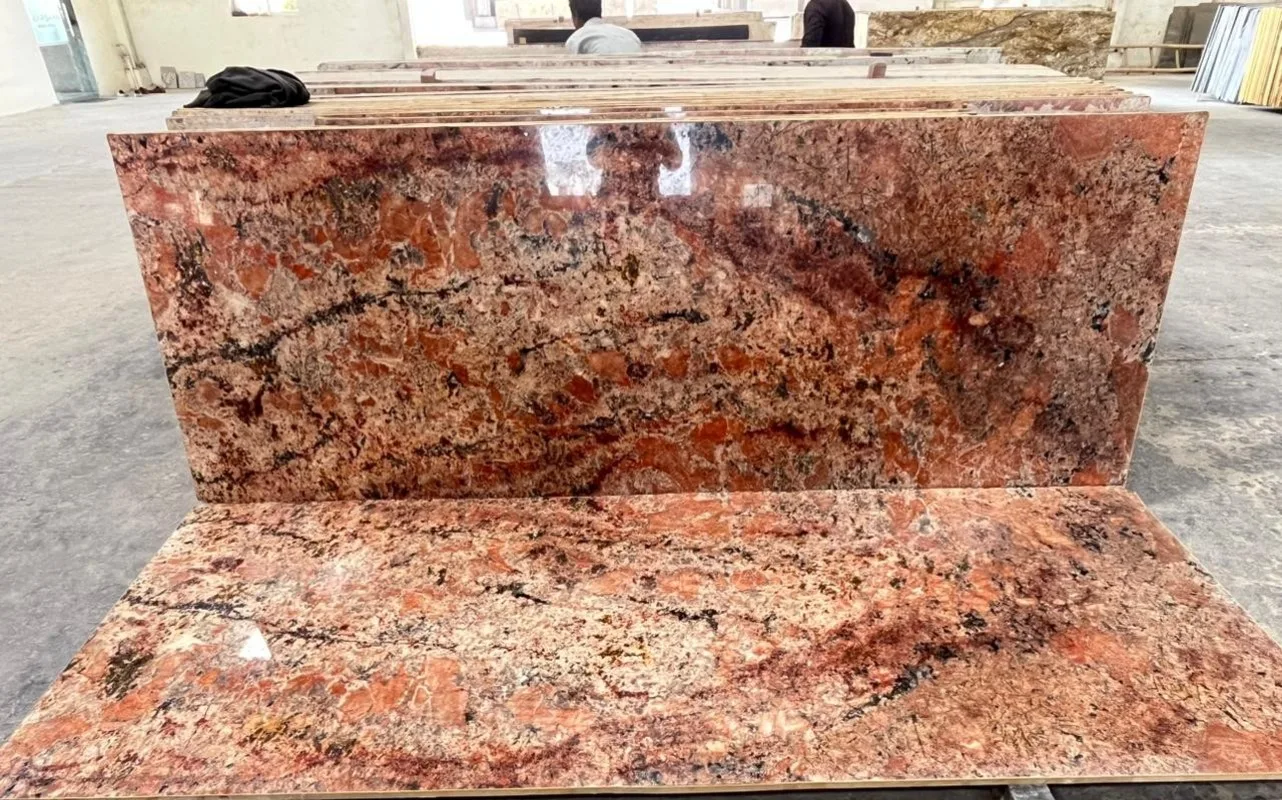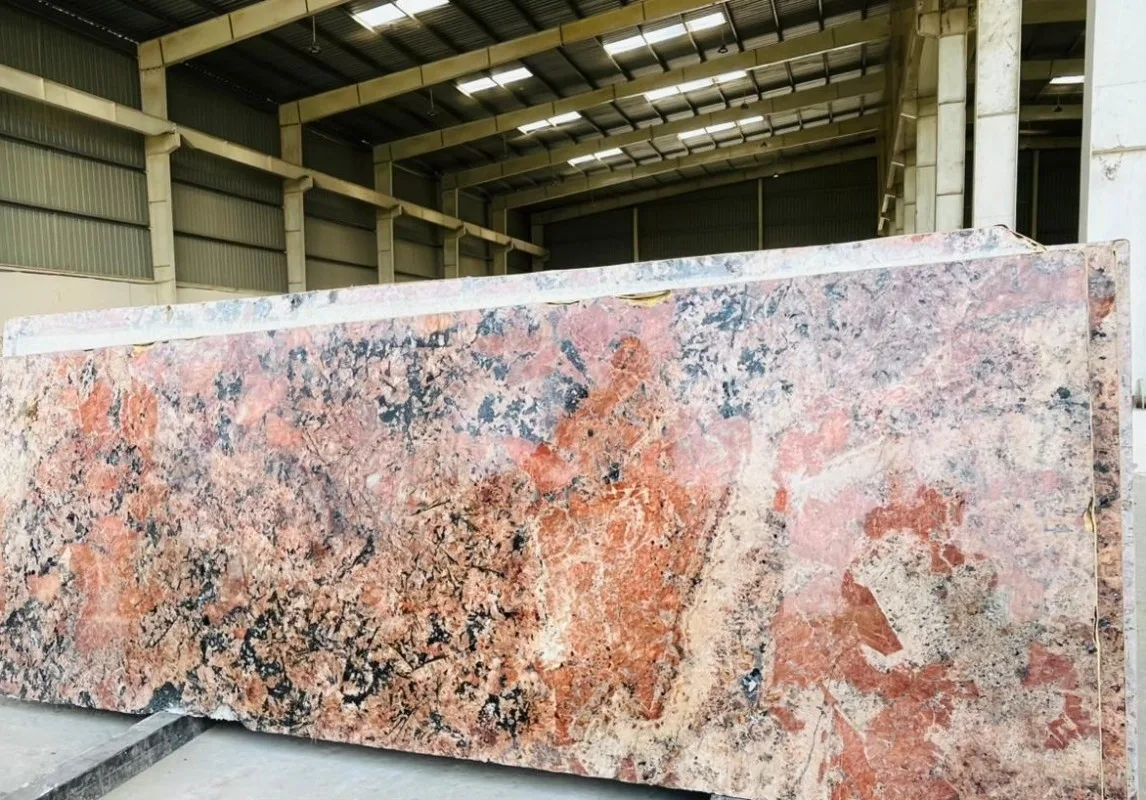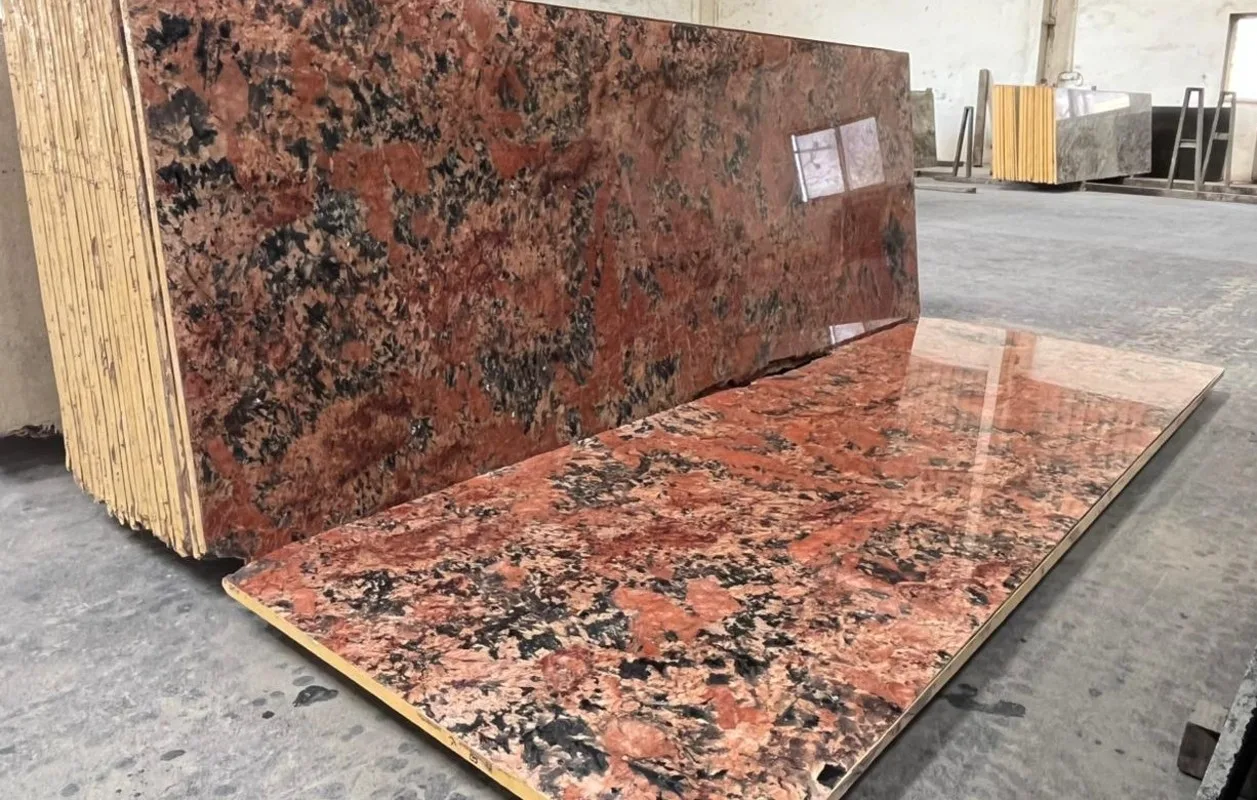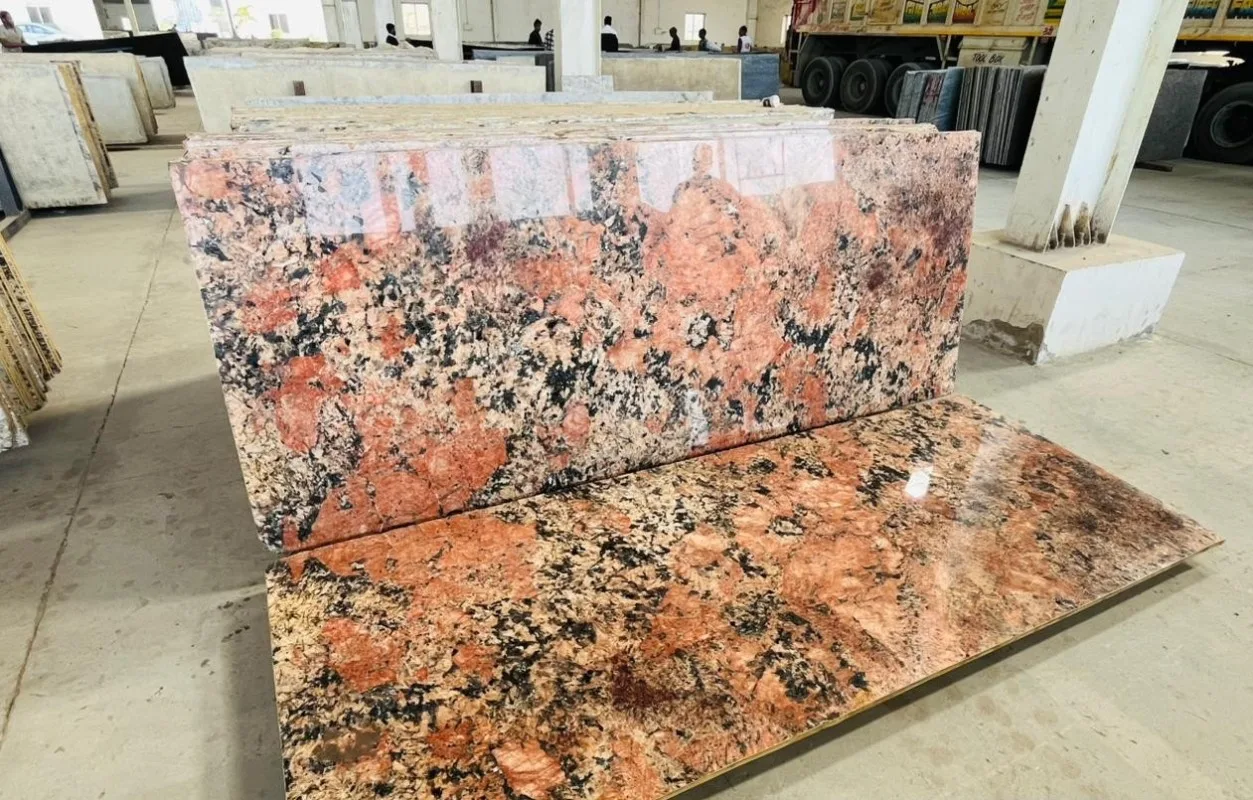
Alaska Red Granite
Alaska Red Granite is a bold and vibrant natural stone known for its deep red background beautifully blended with black, grey, and occasional white mineral speckles. This striking color combination creates a powerful visual impact that instantly enhances any architectural or interior design project. Quarried mainly in the stone-rich region of Rajasthan, India, Alaska Red Granite is widely appreciated for its durability, rich color consistency, and elegant natural texture.
Alaska Red Granite sources from Indian quarries producing this distinctive red-toned granite despite naming suggesting North American origin. The stone showcases rich red to burgundy backgrounds interspersed with black, grey, pink, and occasional white mineral crystals creating dynamic surface texture. Medium to coarse grain structure reveals feldspar minerals generating primary red coloring while darker biotite and lighter quartz components provide contrasting visual elements. Compression testing demonstrates solid structural performance and reliable density supporting monument, architectural, and residential applications. Alaska Red serves specialty markets requiring vibrant red granite accepting commercial naming conventions prioritizing established market recognition over geographical accuracy, with Indian production ensuring consistent international supply.
Those drawn to Alaska Red’s fiery depth will find a kindred spirit in Imperial Red Granite — a bold Indian red stone that brings similar warmth and intensity to monumental facades and high-traffic commercial flooring.
Volga Red Granite, Zulia Red Granite, Indian Alaska Red Granite, Royal Red Granite, Premium Red Granite etc.
If Alaska Red’s dramatic veining appeals to you but you need a slightly lighter tonal variation, New Imperial Red Granite offers a refined crimson palette well-suited for stair treads and feature wall cladding.
Parameter | Description |
| Slab Sizes | Gang Saw Slabs: 280 x 180 CM up in 2, 3 CM, and other Cutter Slabs: 180 x 60 CM up in 2, 3 CM, and other |
| Tiles | 30×30, 30×60, 40×40, 60×40, 60×60, 60 x 90, 60×120 CM in various thicknesses and custom sizes |
| Thickness | 6 mm, 18 mm, 20 mm, 30 mm & custom options |
| Others | Window sills, thresholds, monuments, steps & treads, flagstones, & articles available in custom sizes |
| Finishes | Polished, honed, leathered, bush hammered, lepatora, flamed, shotblasted |
| Standard Thickness | 18 MM (other thicknesses available) |
| Place of Origin | North India |
Alaska Red Granite accommodates finishing methods emphasizing red coloring and mineral contrasts:
Polished Finish – Intensifies red saturation and mineral definition through mirror-like reflectance, creating vibrant presentation where color impact drives design.
Honed Finish – Produces smooth matte surfaces softening red intensity while preserving mineral character, chosen when seeking toned warmth.
Leathered Finish – Develops textured planes maintaining color vibrancy while adding tactile dimension, increasingly specified in residential applications.
Flamed Finish – Generates rough slip-resistant surfaces through thermal treatment, standard for exterior paving though lightening red tones somewhat.
Brushed Finish – Creates moderate friction balancing aesthetic warmth against practical traction for flooring installations.
Natural Cleft – Preserves geological texture occasionally used for rustic cladding though less common in refined applications.
For outdoor landscaping and paving projects where the red palette of Alaska Red is desired but a coarser texture is preferred, Jhansi Red Granite delivers superior slip resistance and exceptional weather durability.
Alaska Red Granite addresses installation contexts where red coloring advances functional and aesthetic objectives:
Monument Construction – Provides material for memorial installations where red symbolism carries cultural significance and granite durability ensures longevity.
Kitchen Countertops – Functions in traditional and transitional culinary spaces where warm red creates inviting focal surfaces.
Exterior Cladding – Addresses building facades and architectural details where distinctive red creates visual impact with weather resistance.
Fireplace Surrounds – Frames hearth openings where red naturally complements fire element creating thematic unity.
Landscape Features – Serves outdoor paving and hardscape elements where color permanence withstands environmental exposure.
Commercial Accents – Operates as architectural highlights in hospitality and retail environments seeking warmth and distinction.
Buyers exploring the red granite family often pair Alaska Red countertops with Red Multi Granite for flooring — its varied tonal mix of reds and browns creates a layered, earthy design language across large spaces.
Alaska Red Granite offers benefits rooted in chromatic properties and material performance:
Color Warmth – Red tones create psychological comfort and energy distinct from cool neutral alternatives dominating construction markets.
Pattern Activity – Mineral diversity camouflages operational wear patterns and minor soiling extending apparent material lifespan.
Cultural Resonance – Red granite carries symbolic associations within various traditions connecting contemporary projects to historical meanings.
Design Coordination – Warm palette pairs effectively with wood elements, bronze hardware, and earth-toned materials in residential construction.
Thermal Performance – Substantial density provides beneficial thermal mass moderating temperature fluctuations in building applications.
Supply Reliability – Established Indian production ensures consistent availability despite Alaska naming, supporting project timelines.
Alaska Red’s striking crimson base pairs dramatically with Absolute Black Granite — designers frequently use the two together as contrasting borders or inlay work to create a bold geometric visual impact.
Alaska Red Granite requires appropriate maintenance acknowledging red coloring characteristics:
Sealing Application – Apply penetrating sealer after installation; red coloring typically conceals any minor darkening from treatment.
Routine Cleaning – Use pH-neutral stone cleaners and soft cloths; red granite forgives minor cleaning irregularities better than high-contrast materials.
Stain Management – Address spills promptly particularly from oils and pigmented liquids; mineral patterns help camouflage minor incidents.
Color Stability – Iron oxide minerals producing red coloring demonstrate exceptional permanence maintaining appearance through years of exposure.
Surface Protection – Employ cutting boards and trivets despite granite durability; protective practices preserve finish quality.
Professional Restoration – Significant dulling or damage warrants stone care specialists ensuring appropriate treatment approaches.
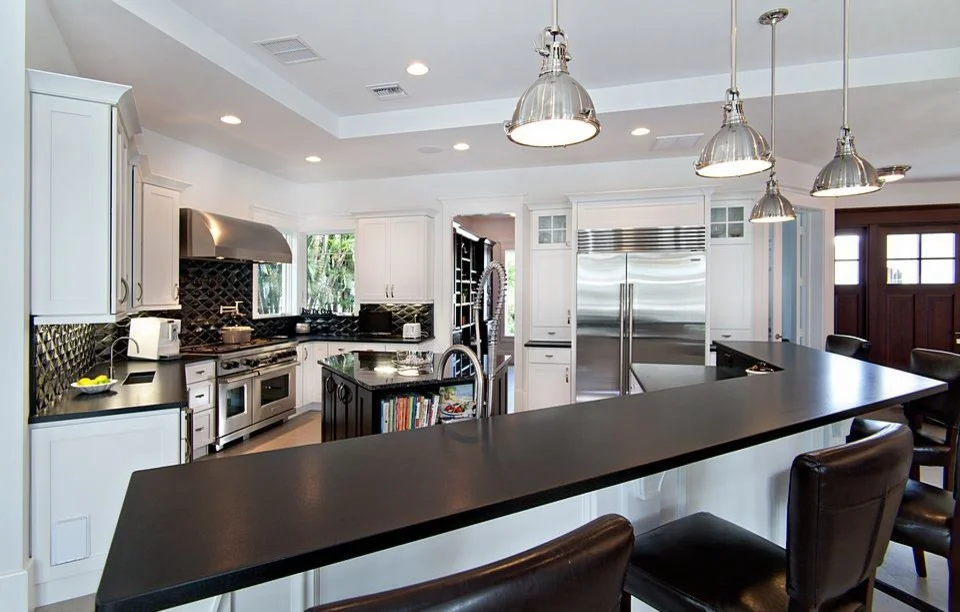
For kitchen projects where Alaska Red forms the island countertop, Black Galaxy Granite serves as an elegant perimeter counter — its golden speckles against a jet-black base beautifully complement the red stone’s warmth.
Property | Details |
| Origin | United States (primarily Alaska, specifically near Ketchikan in southeastern Alaska) |
| Color | Medium to deep red-brown background with black, dark gray, and white mineral crystals; warm, earthy tones; medium variation |
| Mineral Composition | Quartz (25-35%), Feldspar – orthoclase and plagioclase (45-55%, red/brown coloration), Biotite mica (10-15%), Amphibole (hornblende), iron oxide minerals (red tones) |
| Classification | Igneous rock – Plutonic granite (medium to coarse-grained) |
| Density | 2,650 – 2,800 kg/m³ (2.65 – 2.80 g/cm³) |
| Porosity | Low: 0.5 – 1.2% (by volume) |
| Water Absorption | Low: 0.20 – 0.50% (by weight) per ASTM C97 |
| Compressive Strength | 1,600 – 2,450 kg/cm² (157 – 240 MPa / 22,800 – 34,200 psi) |
| Flexural Strength | 120 – 230 kg/cm² (12 – 23 MPa / 1,740 – 3,335 psi) per ASTM C880 |
| Mohs Hardness | 6 – 7 (hard, scratch-resistant) |
| Frost Resistance | Excellent – ideal for exterior use in all climates including severe freeze-thaw environments (quarried in Alaska) |
| Acid Resistance | Good – resistant to most household acids; better than marble or limestone |
| Heat Resistance | Excellent – withstands high temperatures (up to 250°C / 482°F continuous); avoid sudden thermal shock |
| Abrasion Resistance | High: 25 – 32 on Hardness Abrasion (HA) scale per ASTM C241 |
| Stain Resistance | Good – moderate porosity requires sealing; sealed surface resists most stains effectively |
BBV Impex sources Alaska Red Granite from Indian quarries producing characteristic red coloring and balanced mineral distribution. Quality assessment evaluates color intensity, pattern activity, and structural soundness before approval. As a granite supplier understanding commercial naming, we provide transparent origin documentation. Processing capabilities accommodate standard and custom specifications. Export operations incorporate protective packaging preventing surface marking during international transit. Documentation services manage certifications, customs compliance, and coordinated logistics. Technical consultation addresses color consistency expectations, finish recommendations, and maintenance protocols specific to red granite characteristics.
When Alaska Red is used for flooring in commercial lobbies, Steel Grey Granite works seamlessly as a border stone — its cool, neutral tones ground the red’s vibrancy and lend the space an executive, polished character.
Frequently Asked Questions
Why is it called Alaska Red if it originates from India?
Commercial naming reflects market recognition rather than geographical accuracy. “Alaska Red” became established trade name though production occurs in India. Always verify actual origin regardless of commercial designation.
How does Alaska Red compare to other red granites like Imperial Red?
Alaska Red typically exhibits more varied mineral patterns versus Imperial Red’s sometimes more uniform red. Specific comparison requires viewing actual materials as names don’t guarantee appearance differences.
Will red coloring fade over time with sunlight exposure?
Iron oxide minerals producing red demonstrate excellent UV stability. Properly sealed Alaska Red maintains appearance indefinitely indoors; exterior applications show minimal change over decades.
Does red granite show stains more readily than darker varieties?
Busy mineral patterns actually help camouflage staining better than solid-colored stones. However, consistent sealing remains important preventing oils and pigments penetrating surface.
Can Alaska Red work in modern designs or only traditional contexts?
While naturally suited to traditional aesthetics, intentional pairing with contemporary elements can succeed when red becomes deliberate accent. Success requires embracing warmth as design feature.
What cabinet colors complement Alaska Red countertops?
Cream or beige cabinetry harmonizes with warm palette. Natural wood creates traditional coordination. White provides contrast though potentially creating visual busyness. Avoid competing reds or oranges.
How should lighting be designed with Alaska Red granite?
Warm color temperatures (2700-3000K) enrich red saturation. Cool lighting shifts appearance toward purple undertones. Test samples under actual project illumination before finalizing.
Does Alaska Red require special fabrication techniques?
Standard granite fabrication applies though coarse grain sometimes requires experienced cutting preventing excessive chipping. Proper techniques ensure clean edges without material waste.