
Thickness consistency is one of the most critical quality parameters in bulk granite supply. In international trade, even minor deviations can affect installation speed, structural stability, joint alignment, polishing uniformity, and overall project execution. For importers, distributors, contractors, and fabricators, understanding acceptable thickness variation is not a technical luxury- it is a financial necessity.
Granite is processed from natural blocks extracted at quarry level. While modern gangsaws, multi-wire machines, and calibrating lines significantly control dimensional accuracy, variation cannot be eliminated entirely. The key is defining what is acceptable, measurable, and contractually agreed.
Standard Nominal Thickness vs. Actual Thickness
Bulk granite slabs are generally ordered in nominal thicknesses such as:
- 18 mm (often marketed as 2 cm)
- 20 mm
- 30 mm (3 cm)
However, nominal thickness does not mean exact thickness across every square inch. During block cutting and polishing, material loss occurs due to:
- Saw blade vibration
- Diamond wire deflection
- Polishing abrasion
- Surface calibration
- Resin filling and curing
As a result, a slab sold as 20 mm rarely measures exactly 20.00 mm at every point.
Industry-Accepted Thickness Tolerance Ranges
In export-grade bulk granite orders, acceptable thickness variation typically falls within:
For Calibrated Slabs
- ±1 mm for 18 mm and 20 mm slabs
- ±1.5 mm for 30 mm slabs
For Non-Calibrated Slabs
- ±2 mm or more, depending on processing method
Calibrated slabs are processed through automatic thickness calibration machines that grind the backside to maintain uniform thickness. This significantly reduces variation compared to conventional sawn slabs.
For high-precision applications such as modular flooring or pre-fabricated countertops, calibrated slabs are strongly preferred.
Variation Within a Single Slab vs. Across the Shipment
Thickness tolerance must be evaluated at two levels:
1. Intra-Slab Variation
Variation measured at multiple points on the same slab. Excessive intra-slab variation leads to:
- Uneven lippage during installation
- Hollow bedding issues
- Increased adhesive consumption
- Structural stress points
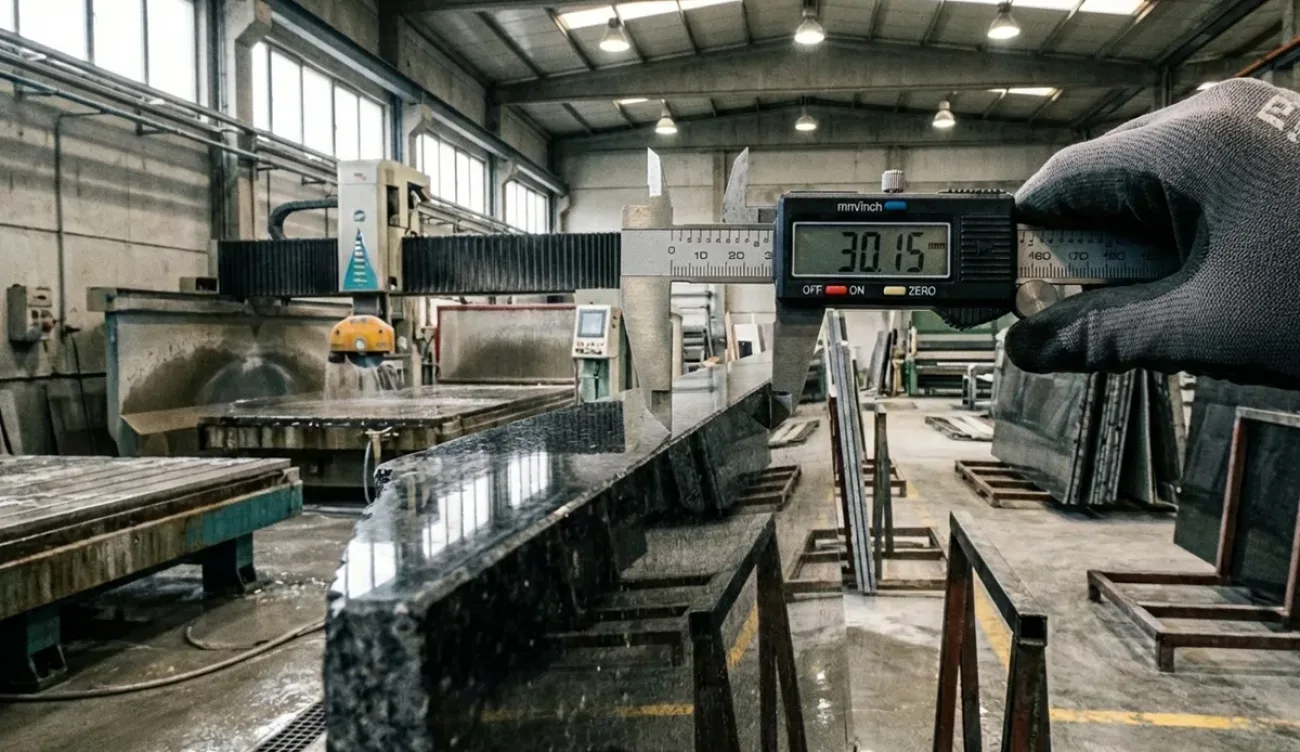
Professional inspection requires digital calipers or thickness gauges at minimum 4–6 locations per slab.
2. Inter-Slab Variation
Difference in average thickness between slabs in the same lot. Even if individual slabs are within tolerance, inconsistent averages across pallets can disrupt fabrication batching.
For large commercial projects, consistent batch thickness is often more important than minimal micro-variation.
Why Thickness Variation Occurs in Bulk Production
Even in advanced facilities, variation may arise due to:
- Natural density changes within the granite block
- Blade wear during long cutting cycles
- Improper block alignment on trolley
- Machine calibration drift
- Uneven pressure during polishing
- Thermal expansion during processing
Granite is not an engineered material; mineral composition shifts within the same block can subtly affect cutting behavior.
Export-level quality control involves monitoring machine calibration daily, not just per production batch.
Impact on Large-Scale Installations
In bulk projects such as malls, airports, hospitality towers, and commercial complexes, thickness variation directly influences:
- Floor leveling accuracy
- Adhesive bed thickness
- Expansion joint alignment
- Stair tread uniformity
- Countertop edge profiling
For flooring, even a 2 mm inconsistency can create visible lippage after installation, particularly under polished finishes where reflection exaggerates unevenness.
For countertops, thickness variation affects sink cutouts, edge laminations, and backsplash alignment.
Contractual Clarity in Bulk Orders
Most disputes in international granite trade arise not from quality defects but from undefined tolerance expectations.
A professional bulk order agreement should clearly specify:
- Nominal thickness
- Maximum allowable deviation
- Measurement method
- Calibration requirement
- Inspection stage (pre-polish or post-polish)
- Acceptance criteria upon arrival
Without defined tolerances, buyers may expect zero deviation- an unrealistic standard in natural stone production.
Clear documentation protects both supplier and importer.
Calibration: When It Is Mandatory
Calibration is essential for:
- Modular tile production
- Pre-fabricated countertop programs
- Thin granite wall cladding
- Raised floor systems
- CNC edge processing
Uncalibrated slabs are generally acceptable for custom fabrication where thickness can be adjusted during cutting.
For European and North American markets, calibrated slabs are frequently specified for large retail distribution due to predictable installation performance.
Thickness Measurement Best Practices
Accurate evaluation requires:
- Digital micrometers with 0.01 mm pr
- Measurements at corners and center
- Measurement after polishing completion
- Avoiding resin-filled depressions
Inspection should be conducted before packing and again randomly during container loading.
Relying solely on visual inspection is inadequate.
Packaging and Loading Considerations
Thickness inconsistency affects packaging stability. When slabs vary significantly:
- Uneven pressure distribution occurs inside wooden bundles
- Increased breakage risk during ocean transit
- Instability in A-frame loading
- Higher insurance claims
Uniform thickness ensures even weight distribution within containers, reducing micro-fractures caused by movement during long shipping routes.
Buyer Expectations in Different Markets
North America
Buyers typically demand tight tolerance due to large-format countertop fabrication and automated CNC processing.
Europe
Strict standards for calibrated flooring materials are common, especially for commercial use.
Middle East
Bulk flooring often tolerates slightly wider deviation if installed over thick mortar beds.
Southeast Asia
Preference varies depending on project scale and installation method.
Understanding destination market expectations prevents post-shipment disputes.
Quality Control Before Export Dispatch
Professional export practice includes:
- Random slab thickness audits per container
- Segregation of out-of-tolerance slabs
- Documentation of inspection results
- Photo and video records
- Clear labeling of calibrated vs non-calibrated bundles
Thickness control should never be left to last-stage packing teams. It must be monitored throughout production.
When Thickness Variation Becomes a Defect
Thickness deviation becomes unacceptable when:
- It exceeds contractual tolerance
- It compromises structural strength
- It affects polishing consistency
- It causes measurable slab warping
- It prevents proper installation alignment
A 1 mm deviation may be acceptable in flooring but unacceptable in laminated countertop fabrication.
Context defines acceptability.
Aligning Expectations Before Production Begins
Before block cutting starts, professional suppliers confirm:
- Target thickness after final polish
- Calibration requirement
- End-use application
- Fabrication method
- Project type
Bulk granite supply is not just about stone color and finish. Dimensional precision defines whether a shipment performs successfully at the job site.
Thickness tolerance is a technical specification — not a casual detail.
For serious buyers, thickness consistency should be discussed as rigorously as color uniformity, surface polish, or slab size.
About BBV Impex
BBV Impex is a leading marble and granite exporter & supplier known for its honesty, consistency, and deep understanding of natural stones. We source our materials directly from trusted quarries and deliver carefully processed slabs and blocks to clients worldwide. Our team believes in long-term relationships built on trust, quality, and commitment. From classic marbles to durable granites, every stone we supply carries the mark of fine craftsmanship and natural beauty. At BBV Impex, we don’t just trade stones — we help builders, architects, and homeowners bring their design ideas to life.