
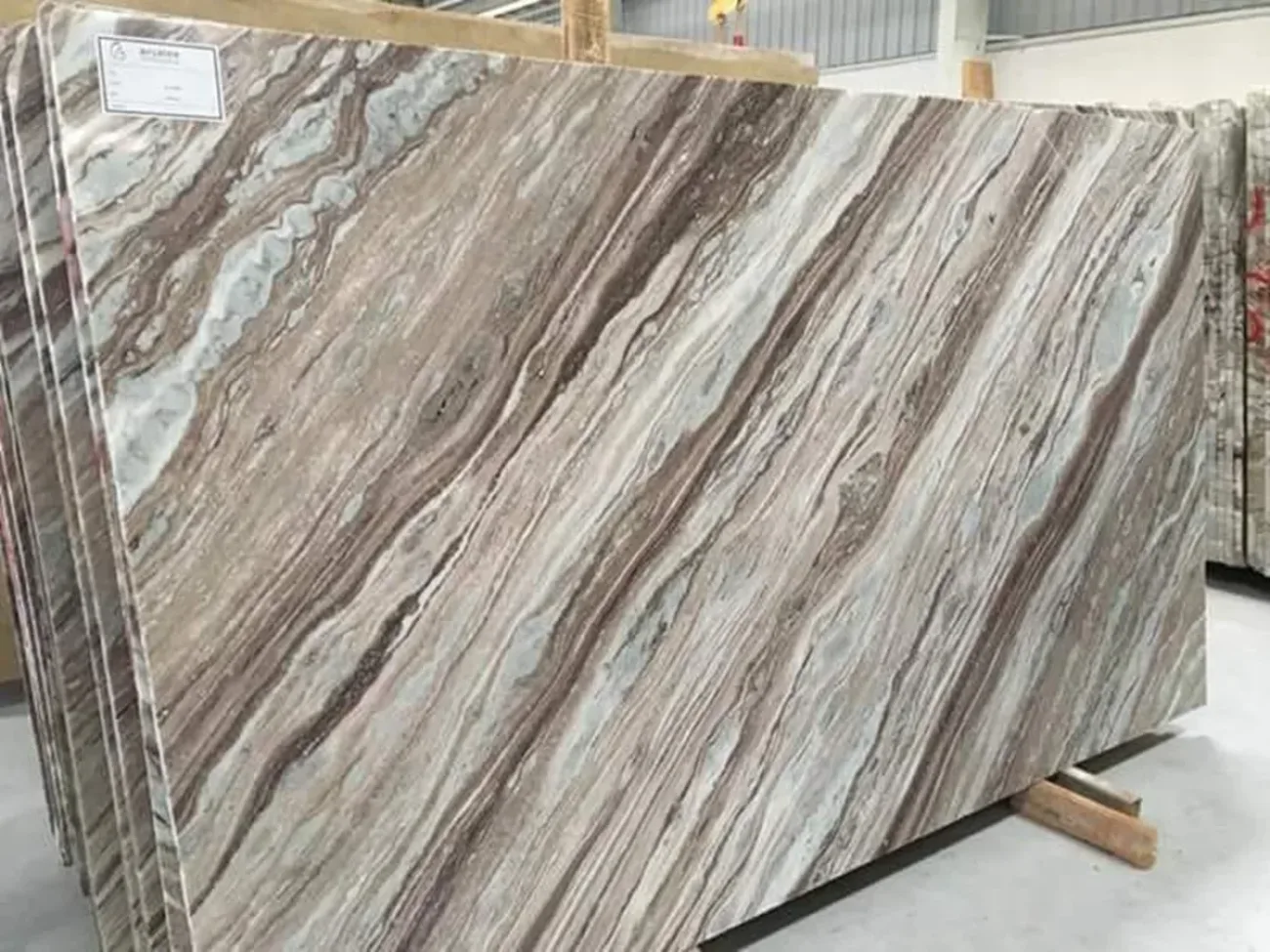
Fantasy Brown Marble is widely specified for countertops, wall cladding, and high-end interior projects because of its flowing patterns and warm brown-gray movement. Yet in export trade and fabrication yards, one recurring issue surfaces: some slabs show bending or warping after cutting.
This behavior is not random. It is almost always linked to geological structure, internal stress distribution, moisture dynamics, and improper processing controls. Buyers who understand these factors can avoid costly site-level failures and shipment disputes.
1. Geological Composition and Structural Behavior
Fantasy Brown is often commercially classified as marble, but geologically it sits between marble and quartzite in many quarries. The material typically contains:
- Calcite-rich marble bands
- Quartz-rich sections
- Directional mineral layering
This mixed composition creates variable density zones within the same slab. When a large gang saw cuts through the block, internal equilibrium shifts. If the mineral bands are unevenly distributed, stress is released asymmetrically, causing slight curvature.
Slabs cut parallel to dominant mineral veining behave differently than slabs cut across it. Cross-cut slabs are generally more stable because stress distribution remains more uniform. Vein-cut slabs, especially in highly layered blocks, are more prone to movement.
2. Residual Quarry Stress in the Block
Blocks extracted from quarries hold natural tectonic stress. When the block is confined, those stresses remain balanced. Once sliced into slabs:
- Confinement is removed
- Internal tension redistributes
- The slab may slightly bow
Blocks sourced from deeper quarry benches often carry higher compressive history. If block conditioning is rushed before cutting, warping risk increases.
Professional exporters insist on:
- Proper block seasoning time
- Visual inspection of natural fractures
- Avoidance of blocks with excessive shear lines
Blocks that appear visually attractive but contain internal stress fractures are common causes of slab deformation.
3. Thickness Reduction and Structural Weakening
Warping frequently appears after slabs are cut to thinner gauges such as:
- 18 mm
- 15 mm
- 12 mm
The thinner the slab, the less resistance it has against stress redistribution.
Fantasy Brown marble is structurally stable at 20 mm and 30 mm in most cases. Problems begin when commercial pressure forces factories to produce thinner slabs for price competitiveness or lightweight installation requirements.
Export-grade processing must respect structural limits. Attempting aggressive thickness calibration without considering mineral layering leads to slab memory movement.
4. Moisture Absorption and Uneven Drying
Fantasy Brown contains calcite zones that absorb moisture more readily than quartz-rich areas. During:
- Resin application
- Water-based polishing
- Wet cutting
Moisture enters the slab. If drying conditions are inconsistent, differential contraction occurs.
One side of the slab may dry faster than the other. This imbalance creates temporary or sometimes permanent warping.
Proper factory practice includes:
- Uniform airflow drying racks
- Avoiding direct sun exposure during drying
- Controlling humidity in polishing sheds
Poorly ventilated facilities significantly increase deformation risk.
5. Resin Treatment and Curing Imbalance
Most export-quality Fantasy Brown slabs undergo resin reinforcement. The purpose is to:
- Strengthen micro fissures
- Improve surface integrity
- Increase polishing quality
However, resin application can introduce tension.
If resin curing temperature is uneven or if slab backs are not evenly coated, tension differential develops between the front and back surfaces. When slabs are later calibrated or cut into smaller pieces, that tension imbalance releases as bending.
Professional factories maintain:
- Controlled oven temperature
- Balanced front and back resin application
- Minimum 24–48 hour curing stabilization
Shortcuts in curing cycles are a frequent hidden cause of slab distortion.
6. Cutting Orientation and Stress Release
The method of cutting directly influences slab behavior.
Gang saw cutting generates gradual stress release.
Bridge saw or multi-wire cutting can create faster release patterns.
If block alignment inside the gang saw does not follow natural bedding orientation, internal tension releases unevenly. Slabs at the outer edges of the block are particularly vulnerable.
Experienced inspectors evaluate:
- Slab position sequence
- Warping trends from outer to inner cuts
- Repeated curvature patterns within the same block
When warping repeats systematically, the root cause is usually structural rather than processing-related.
7. Temperature Fluctuations During Storage
Fantasy Brown slabs stored vertically in open yards are exposed to:
- Day-night temperature shifts
- Direct sunlight on one surface
- Wind exposure on one side
Stone expands and contracts with temperature change. When one face heats more than the other, temporary bowing may occur.
Although slight curvature can normalize indoors, repeated thermal cycling may create semi-permanent distortion.
Export-grade storage protocols require:
- Covered sheds
- Balanced air exposure
- Proper A-frame support spacing
Improper stacking during pre-shipment staging is a common oversight in smaller factories.
8. Improper Back Support During Calibration
During thickness calibration, slabs pass through grinding heads. If conveyor rollers are uneven or worn:
- Slab weight distribution becomes irregular
- Vibration stress accumulates
- Micro bending begins
Once calibration removes material from the back, structural rigidity reduces. Any imbalance in machine alignment increases risk.
Factories focused on export markets routinely:
- Check roller alignment
- Calibrate head pressure
- Inspect slab flatness immediately after processing
Skipping flatness checks until final inspection is too late.
9. Packaging and Container Loading Pressure
Even stable slabs can warp during logistics if packaging is careless.
Common causes include:
- Uneven wooden supports
- Excessive strap tension
- Slabs packed too tightly without spacer tolerance
- Container floor irregularities
When slabs remain under compression for 30–45 days during sea transit, minor stress can become visible curvature.
Export packaging must ensure:
- Equal bottom support
- Symmetrical strapping
- Anti-vibration cushioning
- Compliance with international moisture control standards
Professional exporters document slab flatness before packing to prevent post-arrival disputes.
10. Buyer Expectations vs. Natural Tolerance
Absolute flatness in natural stone is unrealistic. International tolerance standards generally allow minor variation depending on slab size and thickness.
However, large-format island countertops and book-matched installations demand near-perfect calibration.
Bulk buyers should:
- Specify acceptable flatness tolerance in purchase orders
- Request flatness inspection reports
- Confirm thickness uniformity before shipment
Failure to define tolerance creates unnecessary claims and commercial friction.
11. How to Identify Risk Before Shipment
Pre-shipment quality control should include:
- 2-meter straight edge flatness testing
- Feeler gauge measurement at multiple grid points
- Thickness variation checks
- Visual inspection under angled lighting
Any slab showing progressive curvature beyond tolerance should be segregated before container loading.
Reliable marble supplier never rely solely on visual inspection. Measured verification protects both exporter and importer.
12. Practical Risk Mitigation for Bulk Orders
To reduce bending issues in Fantasy Brown:
- Select blocks with minimal shear movement
- Prefer 20 mm or thicker slabs for structural applications
- Ensure proper resin curing cycles
- Maintain controlled drying conditions
- Enforce calibrated flatness inspection
- Use balanced export packaging systems
Projects involving large cantilever installations or thin countertop fabrication should prioritize structural stability over aesthetic flow pattern.
Warping in Fantasy Brown Marble slabs is rarely accidental. It is the outcome of geological structure interacting with processing decisions and logistics handling. When quarry selection, thickness planning, curing control, calibration accuracy, and export packaging are aligned to international standards, bending risk becomes manageable and commercially predictable.