
Polish retention is not about how a slab looks on the polishing line. It is about how that finish survives handling, inspection, crating, sea transit, unloading, fabrication, and installation. Buyers judge the material on arrival— not at dispatch. Measuring polish retention before shipment is therefore a control step, not a cosmetic check.
In export-grade granite, marble, and quartzite, polish retention must be verified through measurable data, controlled handling simulation, and surface performance checks under realistic site conditions.
1. Establish a Baseline Gloss Reading After Final Polishing
Measurement begins immediately after final polishing and before epoxy curing residues or packing dust interfere with readings.
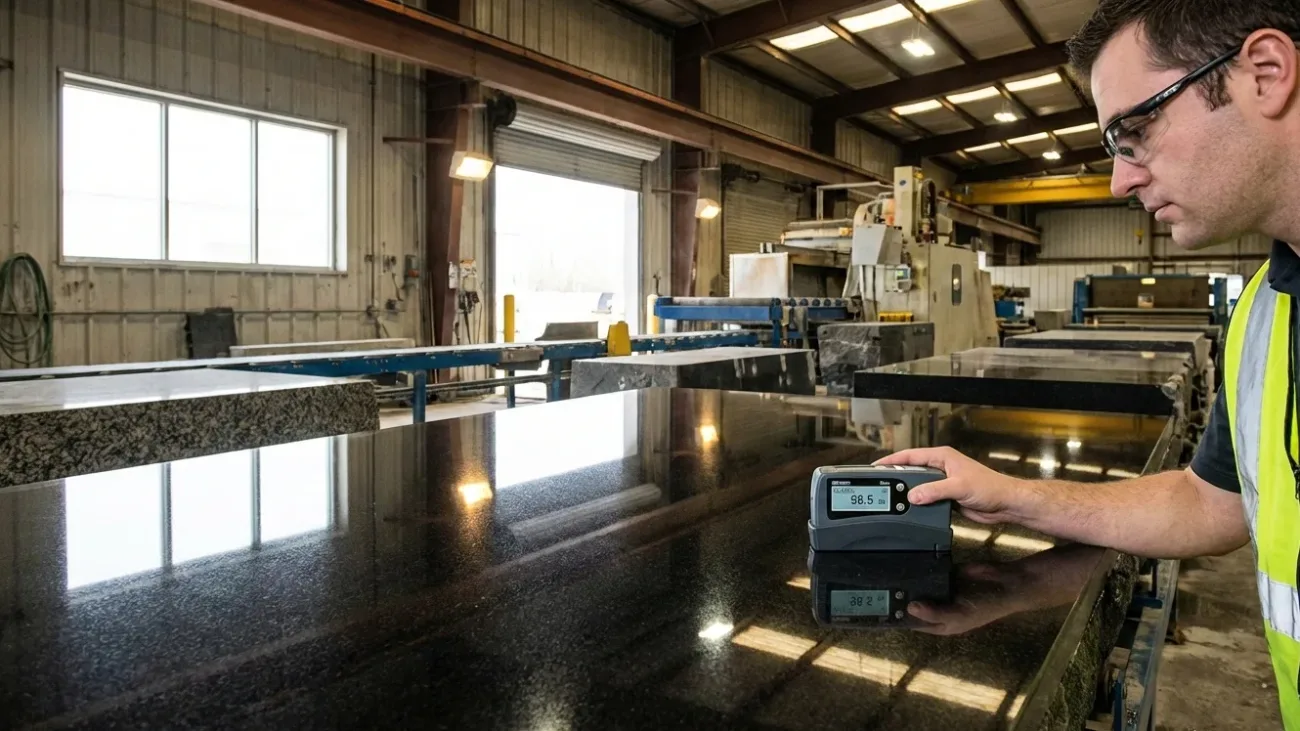
A calibrated gloss meter set at 60° is the standard reference for polished natural stone.
- Premium black granites: 90–95+ gloss units (GU)
- Mid-tone granites and quartzites: 85–92 GU
- Marble: typically 80–90 GU depending on density
Readings must be taken at:
- Center of slab
- Four corners
- Near resin-treated areas
- Along vein transitions in marble
Any variation greater than 3–5 GU across the same slab indicates uneven polishing pressure, pad wear inconsistency, or surface density variation. That slab is already at risk for polish drop during transport.
Baseline documentation is critical because retention is measured against this reference.
2. Perform Controlled Abrasion Simulation
Polish loss during export most often occurs due to:
- Slab-to-slab friction inside bundles
- Micro vibration during ocean freight
- Improper interleaving materials
- Forklift edge contact
Before shipment, simulate mild abrasion using a standardized microfiber rub test:
- Apply uniform hand pressure using a clean dry microfiber cloth
- Rub a 30 cm section for 60 seconds
- Recheck gloss reading
Loss greater than 2 GU indicates weak surface closure. This is common in:
- Under-cured resin-treated slabs
- Marble with incomplete crystallization
- Quartzite with surface micro-fractures
If gloss drops easily under controlled friction, it will not survive container vibration.
3. Check Resin Cure Stability
Many export slabs undergo resin or epoxy treatment. Incomplete curing leads to surface haze, imprint marks, or polish dullness during shipment.
To test retention stability:
- Leave a rubber pad sample pressed against surface for 24 hours
- Remove and inspect for shadowing or imprint
- Recheck gloss meter reading
Any imprint suggests insufficient curing time before packing. This is a frequent cause of claims from Middle East and North American buyers where high site lighting exposes micro haze.
4. Conduct Water Contact Angle Observation
Polish retention is strongly linked to surface pore closure.
Place 3–4 small water droplets on the surface:
- Well-polished granite: droplets remain spherical
- Weak polish: droplets spread quickly
Rapid spreading indicates open micro-pores and insufficient mechanical closure. These surfaces tend to lose shine after first site cleaning.
This test is especially critical for lighter granites and dolomitic marbles.
5. Inspect Under Harsh Light Conditions
Warehouse lighting hides polish defects. Before shipment, slabs must be inspected under:
- Direct LED strip lighting placed at low angle
- Side reflection light test (raking light)
This reveals:
- Swirl marks
- Orange peel texture
- Uneven crystallization
- Micro-scratches from final buffing pad
Any visible pattern under raking light will amplify after installation in commercial projects with strong ceiling lights.
Polish retention includes visual integrity — not just gloss numbers.
6. Edge Polish Verification
Export buyers frequently report polish loss on edges before surface failure.
Check:
- Top 5–10 mm along slab perimeter
- Around cutouts (if pre-fabricated)
- Along chamfered or beveled edges
Edges often receive fewer polishing cycles. During transit, edges absorb most friction inside bundles. A 5 GU drop on edges compared to center is a warning sign.
7. Measure Post-Cleaning Gloss
After final washing and drying (just before packing), repeat gloss readings.
Surface contamination can temporarily inflate gloss values. Post-cleaning measurement gives realistic numbers.
If readings drop significantly after cleaning:
- Polishing slurry residue was masking surface weakness
- Surface was over-buffed rather than properly densified
Export inspection sheets should record:
- Initial gloss
- After abrasion test
- After final cleaning
This creates traceable quality documentation for international buyers.
8. Evaluate Packing Material Compatibility
Polish retention is directly affected by packing.
Before shipment, confirm:
- No acidic paper interleaving
- No rough jute contact with polished face
- Plastic separators are clean and non-reactive
- Wooden crates are moisture-controlled
A simple pre-shipment simulation:
Place packing material samples on the slab surface for 48 hours in humid conditions. Remove and inspect for haze or reaction marks.
Quartzite and resin-treated marble are particularly sensitive to chemical interaction from poor-quality packing foam.
9. Consider Transit Duration and Climate Exposure
Polish retention must account for:
- 30–45 days sea transit
- Container temperature fluctuation
- Humidity shifts
For shipments to regions such as humid Gulf countries or cold North American winters, slabs must demonstrate stability under condensation cycles.
If stone shows micro dulling after controlled moisture exposure in factory conditions, it will worsen in transit.
10. Define Acceptable Polish Retention Tolerance
Export-grade acceptance standards typically allow:
- Maximum 3 GU drop from baseline before shipment
- No visible swirl marks under raking light
- No edge dullness visible from 1.5 meters
- No resin imprint marks
- No friction haze after dry rub test
Anything beyond these limits becomes a future claim risk.
11. Documentation for Buyers
Professional exporters include:
- Gloss meter calibration record
- Slab-wise gloss data sheet
- Photographs under raking light
- Confirmation of resin curing period
- Packing material specification
Serious importers and project contractors expect measurable proof, not verbal assurance.
12. Common Causes of Polish Loss Before Shipment
Repeated field observations show polish retention failures usually originate from:
- Rushed dispatch after polishing
- Insufficient resin curing time
- Worn polishing abrasives
- Overheated polishing heads causing surface burn
- Improper bundle pressure during strapping
- High moisture exposure before container sealing
These are production discipline issues— not material defects.
Final Practical Insight
Polish retention should be treated as a performance parameter, similar to thickness tolerance or flatness calibration. A slab that looks perfect on the polishing line but loses gloss during shipment damages credibility in export markets.
Measurement before shipment must combine instrument readings, controlled abrasion simulation, environmental exposure checks, and realistic packing validation. When polish retention is verified under these conditions, slabs arrive with the same reflective strength they had at dispatch — and that is the standard serious buyers expect.