
Micro cracks are among the most expensive mistakes in stone exports. They are rarely visible in a casual yard inspection, yet once the material reaches a foreign warehouse, they become claims, credit notes, replacements, and damaged relationships. Detecting them before container loading is not a polishing-line responsibility alone; it is a structured inspection process that begins at block selection and ends at the container door.
Understanding Where Micro Cracks Originate
Micro cracks are not random. They are created by stress.
In granite, they often develop from internal geological tension, improper blasting at the quarry face, or excessive wire-saw vibration. In marble and quartzite, they frequently result from natural veining tension, resin curing imbalance, aggressive calibration, or high-pressure polishing.
Thermal variation during drying, especially after resin treatment, can also create hairline fissures that are invisible until slabs are exposed to sunlight at destination ports. If detection is attempted only at loading time, the process has already failed upstream.
Container-level inspection must therefore assume that micro cracks may exist even when surfaces look flawless.
Block-Level Screening Before Processing
Micro crack prevention begins at block yard selection.
1. Visual Stress Mapping on Rough Blocks
Look for:
- Subtle linear shading patterns
- Unnatural straight tension lines
- Surface spider-web hairlines near corners
- Micro open veins along drill lines
Blocks extracted using controlled wire cutting generally show fewer stress fractures than those removed by aggressive blasting. Rough blocks from tension zones in the quarry should be downgraded for smaller slab production.
Rejecting a questionable block at yard stage is cheaper than rejecting 12 bundles at port.
Slab-Level Inspection After Cutting
Once slabs are cut, micro cracks become easier to detect—but only under controlled inspection conditions.
2. Backside Examination Under Direct Light
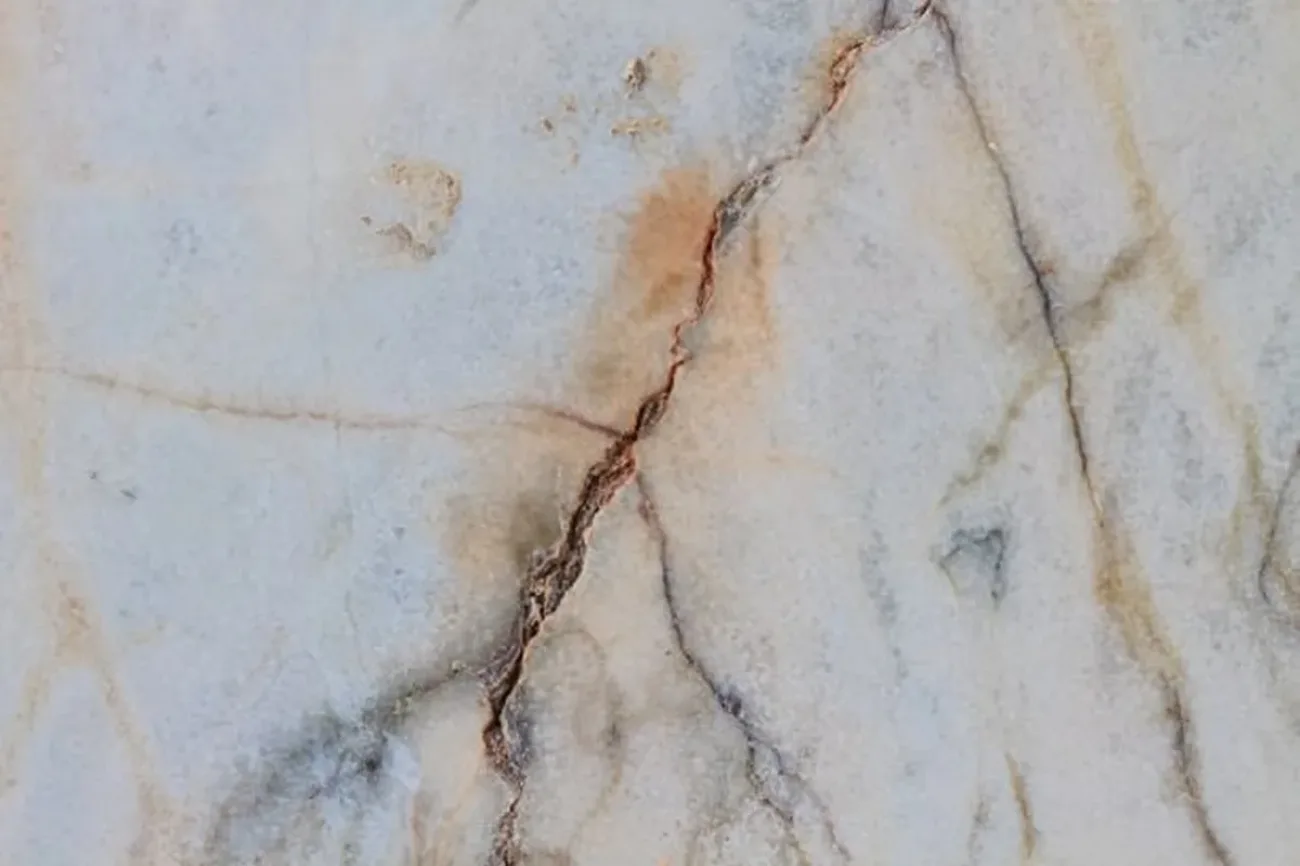
Turn slabs upright and inspect the backside under strong, angled LED lighting. Micro cracks reflect light differently than natural grain lines. They appear as:
- Thin, continuous hairlines
- Slightly darker or lighter streaks
- Short fracture marks near slab edges
Never inspect slabs under diffused warehouse lighting. Direct beam inspection reveals tension lines that overhead lighting hides.
3. Edge Micro Fracture Testing
Edges expose structural truth.
Run a dry cloth along the calibrated edge. If fibers catch, microscopic fractures may be present. Inspect especially near:
- Vein transitions in marble
- Color band changes in quartzite
- Dark-to-light mineral shifts in granite
Edges are stress concentration points. If micro cracks exist internally, they often surface there first.
Tap Testing for Internal Integrity
A calibrated tap test remains one of the most reliable field methods before container loading.
4. Controlled Hammer Sound Test
Using a small rubber mallet:
- Tap evenly across grid sections of the slab.
- Listen for dull or hollow sound variation.
- Compare against a control slab known to be crack-free.
A consistent ringing sound indicates structural continuity. A dull response in a localized area suggests internal fissuring or resin separation.
Tap testing must be systematic, not random.
Resin Penetration Analysis
Many export-grade marble and quartzite slabs are resin-treated. Resin can mask micro cracks rather than eliminate them.
5. Resin Line Observation Under Backlight
Hold thin slabs against strong backlighting.
Look for:
- Uneven resin flow lines
- Resin pooling within narrow channels
- Fine white or gray streaks under the polish
If resin penetration is concentrated in one region, it may indicate a pre-existing micro crack network that absorbed resin during vacuum treatment.
Such slabs may pass polishing inspection but fail during fabrication overseas when cut for countertops or stair treads.
Thermal Exposure Simulation Before Loading
Container transport exposes stone to extreme temperature changes—especially shipments crossing from India or the Middle East to North America or Europe.
6. Sun Exposure Test
Place suspect slabs in direct sunlight for several hours before loading.
Micro cracks often expand under heat. Fine hairlines that were invisible in shade may appear once the slab warms. This is particularly relevant for dark granites and dense quartzites.
Ignoring thermal testing leads to post-arrival cracking complaints.
Moisture Interaction Assessment
Micro cracks absorb moisture faster than intact stone.
7. Controlled Surface Wetting
Lightly mist a small surface area and observe:
- Does water trace a thin line?
- Does a faint crack become darker?
- Does moisture travel in a narrow path?
Water tracing reveals hidden fractures that dry inspection cannot detect. Perform this only on slabs that are fully dried afterward to avoid staining.
Flatness Calibration as a Crack Indicator
Subtle warping may signal internal stress fractures.
8. Straightedge and Feeler Gauge Testing
Place a precision straightedge across the slab diagonally and longitudinally.
If deviation exceeds tolerance in a localized area, internal stress may be present. Micro cracks sometimes alter tension balance, causing slight bowing not visible to the eye.
International buyers, especially fabricators, check flatness before cutting. If they discover bowing caused by hidden fissures, the entire bundle can be rejected.
Bundle-Level Inspection Before Container Loading
Inspection must not stop at slab level. Pressure inside bundles can aggravate micro cracks.
9. Bundle Compression Review
Before strapping:
- Ensure uniform spacer placement.
- Avoid uneven wooden supports.
- Confirm no slab edge is bearing concentrated pressure.
Improper bundling can convert hairline fissures into visible cracks during sea vibration.
After strapping, re-check visible slab faces. Stress from tightening can expose previously hidden fractures
Container Vibration Risk Evaluation
Sea freight involves constant vibration.
Slabs with minor micro cracks may survive yard handling but fail during transit.
10. Edge Padding and Load Stability
Use:
- High-density foam edge guards
- Anti-slip rubber strips
- Tight wooden blocking to prevent micro-movement
Movement amplifies existing fissures. Micro cracks expand under repetitive vibration. If slabs shift even slightly during transport, small defects become structural failures.
Documentation and Buyer Transparency
High-end importers and distributors conduct arrival inspection under warehouse LED and natural sunlight.
For premium projects, especially commercial flooring or large-format wall cladding, even microscopic fissures are unacceptable.
Maintain:
- Pre-loading inspection photographs
- Light test documentation
- Flatness calibration reports
- Bundle packing images
This documentation protects the exporter if damage occurs due to mishandling after discharge.
Critical Zones That Demand Extra Attention
Certain stone types require heightened vigilance:
- Heavily veined marble
- Quartzite with cross-direction mineral bands
- Large-format slabs above 3 meters
- Ultra-thin slabs below 18 mm
- Dark polished granite used for exterior façades
Micro cracks in these materials often remain dormant until fabrication cutting, when CNC machines expose internal stress lines.
Red Flags That Should Trigger Rejection Before Loading
- Repeated dull tap sound in one section
- Linear moisture tracing pattern
- Hairline visible only under angled light
- Edge chipping that follows a straight path
- Localized flatness deviation
A slab showing two or more of these indicators should not be container-loaded for export-grade orders.
Replacing material domestically costs less than replacing it across continents.
Export-Level Reality
International buyers do not judge slabs by how they look in the factory yard. They judge them after cutting, edging, polishing, and installing under site lighting.
A micro crack that appears insignificant at origin becomes a fabrication failure abroad.
Effective micro crack identification before container loading requires:
- Multi-stage inspection
- Controlled lighting
- Sound testing
- Thermal simulation
- Flatness calibration
- Intelligent bundling
Inspection must be methodical, not visual guesswork. Export reputation is built not on what is shipped, but on what arrives intact.